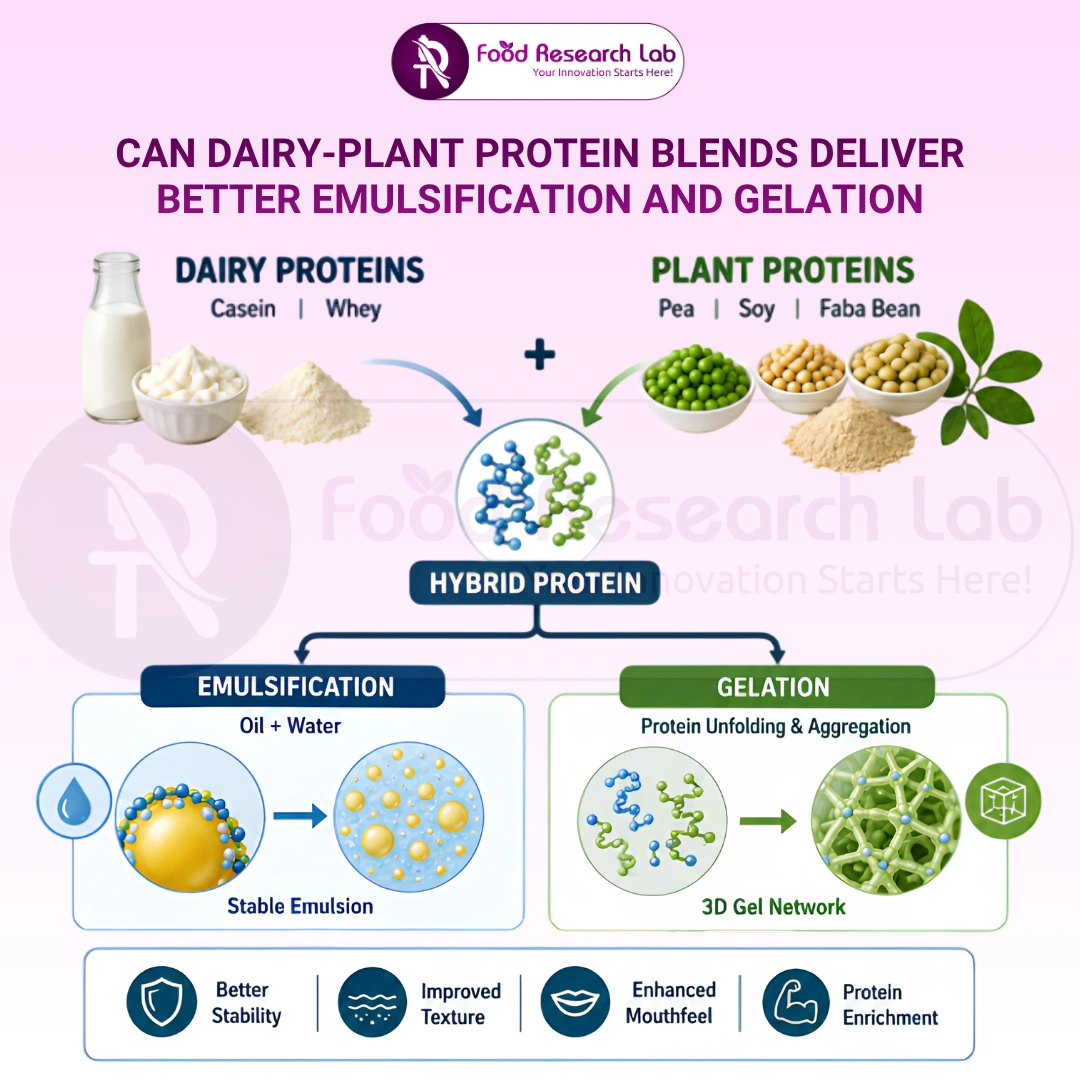
Dairy-plant protein blends involve mixing dairy proteins, such as casein or whey, with plant proteins, such as pea, soy, or faba bean, to alter emulsification, gel properties, texture, and stability. The science is not just about using plant protein to replace dairy protein. It is about controlling how different proteins interact during hydration, homogenization, heating and gelling processes. The 2026 research demonstrates the potential of using these blends to develop hybrid dairy products, although the success is highly dependent on the ratio of proteins and the processing conditions.
Can Dairy-Plant Protein Blends Deliver Better Emulsification and Gelation?
Dairy-plant protein blends involve mixing dairy proteins, such as casein or whey, with plant proteins, such as pea, soy, or faba bean, to alter emulsification, gel properties, texture, and stability. The science is not just about using plant protein to replace dairy protein. It is about controlling how different proteins interact during hydration, homogenization, heating and gelling processes. The 2026 research demonstrates the potential of using these blends to develop hybrid dairy products, although the success is highly dependent on the ratio of proteins and the processing conditions.
For manufacturers, this makes Dairy-Plant Protein Blends a relevant approach to food product development, especially where developers need to balance nutritional value, texture, processing performance, and cost. [1] Growing interest in plant-based and dairy-alternative foods also reflects nutritional and sustainability considerations among consumers. [2]
Hybrid Protein Formulation: Balancing Dairy and Plant Functionality
Dairy and plant proteins have different molecular structures and functional properties. Caseins are highly surface-active and can contribute to emulsification processes, whereas whey proteins can denature during heating and participate in network formation. Plant proteins such as pea, soy and faba bean proteins offer emulsification and gelling properties, although their solubility, aggregation and sensory characteristics differ.
This makes hybrid protein formulation a functional approach rather than simple ingredient replacement. Protein blending can modify protein functionality and properties such as emulsification, solubility, viscosity, and water-holding capacity depending on the protein type and ratio. [3]
Protein | Key functionality | Important formulation factor |
Casein | Emulsification and acid/enzymatic gelation | pH and calcium |
Whey protein | Heat-induced gelation and emulsification | Heating profile |
Pea protein | Protein enrichment and structure | Solubility and aggregation |
Soy protein | Emulsification and gel formation | Protein fraction and heat treatment |
Faba bean protein | Structure and protein enrichment | Processing and flavour |
Research published in 2024 found that protein-protein interactions can play a key role in both emulsification and gelation in milk-plant systems.
How Does Protein Blend Emulsification Work?
Emulsification involves dispersing one immiscible phase, such as oil, in another phase, such as water. Proteins are natural emulsifiers because they interact with both aqueous and oil phases. In protein blend emulsification, proteins adsorb at the oil-water interface to inhibit droplets from coalescing. This process depends on protein concentration, solubility, surface activity, pH, ionic strength, and homogenization.
Homogenization matters because it decreases oil droplet sizes and increases the interfacial area that requires protein coverage. If insufficient protein is available to stabilise the interface, reducing droplet size alone does not improve long-term stability. [3]
Processing Can Change the Outcome
In a 2026 study by Chen et al. on hybrid semi-hard cheese involving pea and faba-bean protein, 20% of the milk protein was replaced with plant protein, using heating temperatures of 60°C and 85°C and homogenization pressures of 5 and 30 MPa before cheese production. Pre-emulsification helped retain plant protein within the curd matrix, showing that processing parameters can substantially affect plant-protein incorporation and the resulting cheese structure. [4]
How Does Dairy-Plant Protein Gelation Work?
Gelation is defined as protein association into a three-dimensional network that immobilises water because of heat, acidification, enzymatic treatment, or a combination of these treatments. Denaturation of whey proteins due to heat treatment and association due to hydrophobic interactions and disulfide bond formation occur. Casein systems are highly sensitive to pH, calcium, and enzymatic coagulation. Plant proteins denature and associate too, but it depends on the composition and extraction technique.
More Plant Protein Does Not Always Mean a Stronger Gel
This is one of the most important findings for dairy-plant protein gelation. According to the paper published in 2026 Food Structure (Vol. 48, Article 100513), a study of pea protein isolate and micellar casein revealed that the two proteins had an antagonistic effect on gel structure under acidic and enzymatic coagulation; the pea-to-casein ratio influenced oil droplet size and the behaviour of the gel. Meanwhile, another 2025 study from the Federal University of Viçosa (Foods, DOI: 10.3390/foods14162887) found that pea-rich casein gels showed increased water-holding capacity, while casein-rich gels showed decreased hardness, reflecting altered protein-protein interactions at different ratios.
The takeaway: a blend should not automatically be assumed better than an individual protein. The objective is identifying a compatible protein ratio and processing window.
What Better Emulsification Means for Your Next Dairy Product
Improved emulsification may play a role in the stabilisation, mouthfeel, and texture of products within various product categories.
Product Category | Effect of Dairy-Plant Blend | Key Consideration |
Protein beverages | Helps control oil separation, sedimentation, and creaming | Emulsion stability at high protein loads |
Yoghurt and fermented products | Can alter gel strength, water-holding capacity, viscosity, and syneresis | Protein-network formation as fermentation lowers pH |
Hybrid cheese | Can influence curd formation, moisture retention, and final texture | Protein type and processing route |
In hybrid cheese, protein structure directly influences curd formation, making it a particularly useful application for plant-dairy product development. In a 2026 review by Sarker et al. bovine milk curd gels were reported to be significantly firmer than hybrid gels containing 40% soy, pea, or faba-bean protein replacement—2.5, 2.7, and 4.8 times firmer, respectively—showing that plant protein source can substantially affect hybrid cheese texture. [5]
How Should Food Developers Optimise the Blend?
A practical food formulation strategy should evaluate the complete processing system, not just the ingredient list.
- Define the target: Identify priorities such as emulsion stability, gel strength, creaminess, water retention, or protein enrichment.
- Select complementary proteins: Compare casein, whey, pea, soy, or faba-bean proteins based on solubility, thermal behaviour, emulsification, and gelation.
- Screen protein ratios: Compare different dairy-to-plant ratios against a dairy-only control.
- Optimise processing: Evaluate hydration, homogenization pressure, temperature, pH, ionic strength, and heating conditions.
- Measure functionality: Assess particle size, emulsifying activity, emulsion stability, rheology, texture, water-holding capacity, and syneresis. Storage modulus (G′) and loss modulus (G″) indicate whether the structure is predominantly elastic or viscous.
- Validate stability: Monitor phase separation, viscosity, texture, and sensory properties during shelf-life testing.
What Are the Main Challenges?
Achieving protein blend stability without undesirable texture is the major challenge. Weak gels, phase separation, sedimentation, poor solubility, excessive viscosity, and plant-protein off-notes are common risks, and protein interactions may change during heat treatment, fermentation, or storage. Gelling agents may still be required, but their use should be based on measured functionality rather than added automatically to compensate for poor protein selection. [1]
What Does the 2026 Research Mean for Food Product Development?
The latest evidence suggests that the future of dairy alternative protein blends is not simply about replacing dairy proteins. It is about engineering protein systems around specific product requirements.
The 2026 literature shows three important lessons:
- Protein ratio matters. Different dairy-to-plant ratios can produce substantially different emulsification and gel structures. [1] [3]
- Processing matters. Heating and homogenization can substantially affect plant-protein incorporation and the resulting structure of dairy systems. [4]
- Protein source matters. Soy, pea and faba-bean proteins can generate different microstructures even at comparable replacement levels. [5]
For new food product development, this supports a more scientific workflow: select proteins according to functionality, optimise their interactions through processing, and validate the resulting structure, stability, and texture using appropriate analytical and sensory methods.
Conclusion
Dairy-Plant Protein Blends may enhance control over emulsification, gelation, and texture when protein type, ratio, pH, heat, and homogenization conditions are carefully optimised. Hybrid protein formulation allows manufacturers to develop functional products based on measurable performance rather than simple ingredient substitution.
Develop Better-Performing Protein-Based Products
Looking to develop a stable dairy, plant-based, or hybrid protein product? Food Research Lab supports food product development services from formulation and ingredient selection to process optimisation, prototyping, and product validation. Work with our food scientists to turn your protein formulation concept into a commercially viable product.
Frequently Asked Question
What are dairy-plant protein blends?
Dairy-plant protein blends involve the combination of dairy proteins like casein or whey with plant proteins such as pea, soy, or faba bean to modify their functionality, structure and nutritional properties.
Do dairy-plant protein blends improve emulsification?
They can improve emulsion stability by combining the interfacial properties of dairy and plant proteins; however, performance may depend on the protein type, ratio, concentration, and processing conditions.
What is protein gelation?
Protein gelation is the process in which proteins associate to form a three-dimensional network that affects texture, firmness, water-holding capacity and stability.
Why blend dairy and plant proteins instead of using one protein?
Blending can balance functionality, nutrition, texture, cost, and formulation requirements while supporting the development of hybrid dairy products.
Which products can benefit from dairy-plant protein blends?
Potential applications include high-protein drinks, yoghurt, fermented products, hybrid cheese, dairy alternatives, desserts, and other structured food products.
References
- Rout, S., Dash, P., Panda, P. K., Yang, P. C., & Srivastav, P. P. (2024). Interaction of dairy and plant proteins for improving the emulsifying and gelation properties in food matrices: A review. Food Science and Biotechnology, 33(14), 3199–3212. https://doi.org/10.1007/s10068-024-01671-4
- Craig, W. J., Messina, V., Rowland, I., Frankowska, A., Bradbury, J., Smetana, S., & Medici, E. (2023). Plant-based dairy alternatives contribute to a healthy and sustainable diet. Nutrients, 15(15), 3393. https://doi.org/10.3390/nu15153393
- Khalesi, M., Dowling, S., Comerford, J., Sweeney, C., Esteghlal, S., & FitzGerald, R. J. (2025). Emulsification properties of plant and milk protein concentrate blends. Foods, 14(19), 3406. https://doi.org/10.3390/foods14193406
- Chen, J., Guo, X., Cornillon, P., Hettinga, K., & Bijl, E. (2026). Development of hybrid semi-hard cheese: The potential of incorporating pea and faba bean proteins. Future Foods, 13, Article 101024. https://doi.org/10.1016/j.fufo.2026.101024
- Sarker, M. A. H., Pillidge, C., Afshari, R., Chandrapala, J., & Gill, H. (2026). Incorporating plant proteins into cheese: Opportunities and challenges (a review). Critical Reviews in Food Science and Nutrition, 1–25. https://doi.org/10.1080/10408398.2026.2645263

Let’s create something Innovative and Delicious together
Food Research Lab strives for excellence in new Food, Beverage and Nutraceutical Product Research and Development by offering cutting edge scientific analysis and expertise.