In the U.S., the beverages industry has been using AI, connected machines, and intelligent automation for enhancing its manufacturing processes and quickening beverage product development for functional beverages, ready-to-drink (RTD) drinks, and plant-based drinks. To stay competitive and keep up with the changing FDA rules, the industries need to invest in Industrial machinery optimization and advanced machinery intelligence to improve production speed, consistency, traceability, and equipment reliability. Between 2025 and 2027, these technologies are expected to drive smarter, more efficient, and scalable beverage manufacturing across the United States. [1]
How USA Beverage Manufacturers Apply Industrial Machinery Optimization for Advanced Machinery Intelligence
In the U.S., the beverages industry has been using AI, connected machines, and intelligent automation for enhancing its manufacturing processes and quickening beverage product development for functional beverages, ready-to-drink (RTD) drinks, and plant-based drinks. To stay competitive and keep up with the changing FDA rules, the industries need to invest in Industrial machinery optimization and advanced machinery intelligence to improve production speed, consistency, traceability, and equipment reliability. Between 2025 and 2027, these technologies are expected to drive smarter, more efficient, and scalable beverage manufacturing across the United States. [1]
Why the USA Beverage Industry Is Accelerating Machinery Intelligence
Unlike many other areas of manufacturing, beverage production needs constant processes with an accurate control of the formula, filling, sterilization, carbonation, and packaging. The smallest deviation of equipment can have an impact on the consistency, durability, packaging and safety of products.
Some of the market and regulatory drivers behind the application of the intelligent manufacturing technology throughout the United States include the following:
- The increase in consumer demand for premium, functional and ready to drink beverages.
- Increasing complexity of manufacturing due to multiple SKUs and constant changes between them.
- The lack of workforce and, therefore, the increase in the automation of factories.
- Environmental targets which include lower use of water, energy and material resources.
- Record-keeping and traceability regulations required by FDA in the field of food safety.
To address these challenges, Smart industrial automation, Industrial IoT solutions and connected industrial systems can be used to monitor and analyze equipment performance and optimize production process in real time. [2].
FRL Insight: Machinery optimization has become a critical aspect of Beverage Product Development to integrate intelligent manufacturing technologies for scaling up the formulations from pilot testing to commercial production
What Is Industrial Machinery Optimization in Beverage Manufacturing?
Industrial machinery optimization is an ongoing process aimed at enhancing the performance of beverage formulation machines by using automation, AI, and real-time data to maximize production efficiency while maintaining high quality of products and regulatory compliance. With constant monitoring of the health of machinery and adjusting its settings in real-time, intelligent solutions will minimize process variations and increase Overall Equipment Effectiveness (OEE).
Key Applications Across Beverage Production
Production Stage | Optimisation Objective |
Ingredient dosing | Achieving proper ingredient composition and formulation |
Mixing & blending | Maintaining consistent product quality |
Homogenisation | Maintaining a stable particle size |
Pasteurisation/UHT | Controlling the heating process properly |
Carbonation | Maintaining proper carbon dioxide level |
Filling & capping | Improving bottling accuracy and minimizing losses |
Packaging | Automated Inspection and defect recognition |
CIP systems | Fast cleaning and low resource usage |
Today, modern beverage production plants implement Automated machinery monitoring, intelligent sensors, robotics, and cloud analytics to facilitate Manufacturing process optimization across the production lifecycle. [3]
Emerging Technologies Transforming USA Beverage Plants (2025–2027)
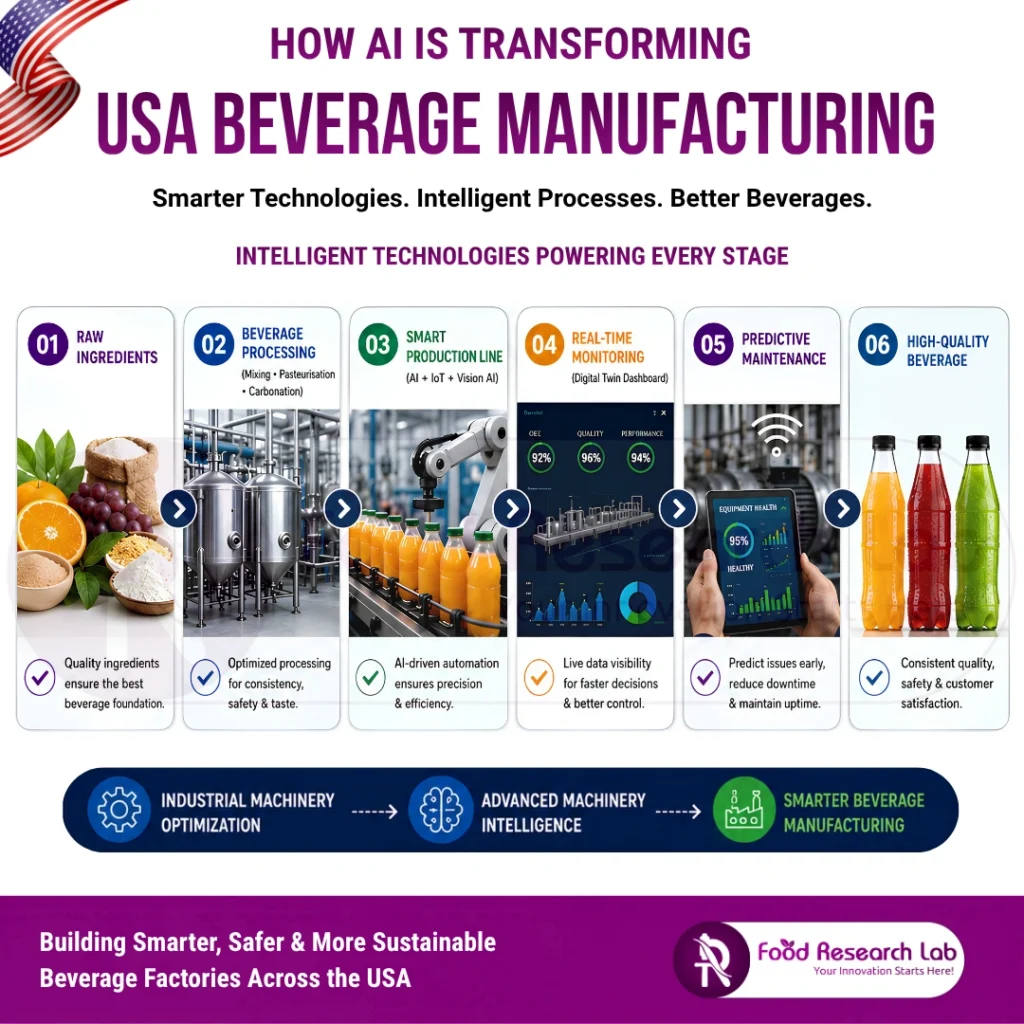
In the United States beverage industry, there is an implementation of AI technologies, industrial connectivity and analytics to develop smart factories. By 2025 to 2027, smart automation technologies, digital twins and connected manufacturing will bring productivity benefits, product quality improvement and better regulation compliance.
AI-Powered Predictive Maintenance Systems
Contemporary predictive maintenance systems rely on vibration testing, thermal imaging, motor current analysis, and acoustic testing to evaluate equipment performance. With machine learning for industrial equipment, such systems identify potential failures in fillers, pumps, compressors, and conveyors before breakdowns occur, reducing downtime and improving asset reliability.
Industrial IoT Solutions and Real-time Equipment Analytics
Industrial IoT solutions integrate the production equipment by means of smart sensors to monitor temperature, pressure, flow rate, fill level and energy consumption. This leads to real-time equipment analytics which allows manufacturers improve process consistency, reduce waste, and make faster operational decisions.
Digital Twins and Intelligent Simulation
By using digital twins, manufacturers can simulate beverage production lines before making changes to the manufacturing process. Models of mixers, pasteurisation, filling and packaging systems increase Manufacturing process optimization, decrease the time for commissioning and reduce risks related to implementation.
Vision AI and Intelligent Process Automation
Vision AI systems analyse bottles, cans, labels, caps and seals very accurately, detecting any defects of the production process. In combination with Intelligent process automation, they help with quality control, minimise manual inspection and allow regulatory compliance.
Edge AI and Connected Industrial Systems
By processing production data using Edge AI, decision-making is faster as there is no need to rely on cloud computing. In combination with Connected industrial systems, it increases production reliability and security and allows process control in real-time.
AI-Driven Industrial Efficiency Solutions
AI-powered energy management systems optimise the use of steam, refrigeration, compressed air and water resources in beverage manufacturing plants. These Industrial efficiency solutions help to achieve sustainability goals and speed up the Digital transformation in manufacturing through smarter resource management. [4] [5]
Applications of Industrial Machinery Optimization and Emerging Technologies Across the USA Beverage Industry
Adaptation to intelligent machinery optimization is different for each beverage category since it requires specific process conditions and standards. The use of AI, automation and IoT by U.S. companies for increased efficiency, consistency and regulatory compliance and development of advanced machinery intelligence.
Beverage Segment | Emerging Technology | Intelligent Application | Key Outcome |
Carbonated Soft Drinks | Process control based on AI and Vision AI | Carbonation control and automated filling | Consistency increase and reduced product losses |
Functional Beverages | AI blending systems, inline sensors | Ingredient dosing and formula monitoring | Batch consistency |
Juice & Fruit Beverages | Digital twins, predictive thermal analysis | Pasteurisation and process optimisation | Enhanced safety and taste retention |
Dairy & Plant-Based Drinks | Predictive maintenance systems, IoT sensors | Homogenization and aseptic processing | Improved reliability and stabilized emulsions |
Sports & Energy Drinks | Vision AI and robotics | Automated packaging inspection | Decreased defects and higher productivity |
Premium RTD Beverages | Smart scheduling, industrial IoT solution | Automated changeovers and production planning | Increased SKU changes speed and flexibility |
FRL Insight: Automation of production processes is being replaced by product-specific automation. Integration of intelligent technology into the Beverage Product Development helps companies to increase scalability, production efficiency, and operational performance.
Case Study: Smart Manufacturing Optimisation for Beverage Product Development
Challenge
A beverage company in the USA experienced issues related to inconsistent production performance, unexpected downtime of the machinery, and problems with scaling the development of their RTD beverage without compromising the quality and compliance.
Solution
Food Research Lab applied an Industrial machinery optimization approach including process validation, Smart industrial automation, and production monitoring to optimize the performance of machinery and production process.
Outcome
The beverage company obtained better production performance, less downtime of the machinery, and accelerated scale up of the new beverage, thus resulting in efficient Beverage Product Development with enhanced manufacturing reliability and regulatory compliance.
Conclusion
Industrial machinery optimization is revolutionizing the U.S. beverage industry with increased production efficiency, product consistency, and compliance owing to advanced machinery intelligence and connected manufacturing technologies. With the further advancement of AI-driven machinery automation, the integration of intelligent manufacturing into Beverage Product Development will be essential for scalable and future-ready production.
Partner with Food Research Lab to speed up your Beverage Product Development Services by implementing advanced formulation, pilot-scale validation, process optimization, and smart manufacturing solutions.
Frequently Asked Question
What is Industrial machinery optimization in beverage manufacturing?
It uses Artificial Intelligence, Automation, and Real-time Data to optimize the working of machinery, minimize downtime, and deliver beverages of constant quality.
How do Industrial IoT solutions improve beverage production?
The solutions allow the connection of machinery using smart sensors so that Real-time equipment analytics can be done to optimize the machinery working and identify any deviation in the process.
Why are Predictive maintenance systems important?
They monitor equipment health in real time to prevent unexpected failures, reduce maintenance costs, and improve production reliability.
What are the Benefits of Real-Time Equipment Analytics?
They provide better control of the production process, optimize the performance of the equipment, reduce energy costs and facilitate quicker decision-making.
How does FRL support intelligent beverage manufacturing?
FRL provides services for beverage product development, process optimization, pilot validation and smart manufacturing solutions to help beverage companies scale production efficiently and meet regulatory requirements.
References
- Raul Mendoza-Sotomayor, Jose Antonio Sabogal-Arias, Juan Carlos Quiroz-Flores, “Optimizing Beverage Manufacturing: Integrating Lean Manufacturing and Machine Learning to Enhance Efficiency and Reduce Waste,” International Journal of Engineering Trends and Technology (IJETT), vol. 72, no. 11, pp. 155-174, 2024. Crossref, https://doi.org/10.14445/22315381/IJETT-V72I11P118
- Winkler, M.R., Antonacci, C.C., Zhang, A.Y. et al.“Games being played”: a US exploration of market strategies used by the beverage industry as experienced by food retailers. Global Health 20, 79 (2024). https://doi.org/10.1186/s12992-024-01073-5
- Galih Patria, D., Selvina Bernas, C., & Lin, J. (2025). Innovations Driving the Future of Beverage Industry. In Food Science and Nutrition. IntechOpen. https://doi.org/10.5772/intechopen.1012478
- Naiya, S. . (2025). AI-Powered Predictive Maintenance in IoT-Enabled Smart Factories. Research Annals of Industrial and Systems Engineering, 2(1), 27-35. https://doi.org/10.22105/raise.v2i1.34
- Subashree, S., Rajakumaran, M., Pushpa, G. et al.Adaptive machine learning models for predictive maintenance in industrial internet of things (IIoT) systems. Sci Rep 16, 12451 (2026). https://doi.org/10.1038/s41598-026-42666-x

Let’s create something Innovative and Delicious together
Food Research Lab strives for excellence in new Food, Beverage and Nutraceutical Product Research and Development by offering cutting edge scientific analysis and expertise.