Functional beverages have been able to move from being niche wellness products to becoming lifestyle essential drinks that offer more than hydration. These drinks are made using scientific and proven compounds such as vitamins, probiotics, proteins, adaptogens, herbs, and minerals and serve to boost the immune system, digestion, brain functions, energy, recovery, and general wellness. In 2026, the increasing levels of health awareness, customized nutrition, and clean labels will further propel the functional beverage market growth, while innovations in the beverage product development allow beverage product manufacturers to create evidence-based products that meet evolving consumer needs. [1]
What Are Functional Beverages and Why Are They Growing in Popularity?
Functional beverages have been able to move from being niche wellness products to becoming lifestyle essential drinks that offer more than hydration. These drinks are made using scientific and proven compounds such as vitamins, probiotics, proteins, adaptogens, herbs, and minerals and serve to boost the immune system, digestion, brain functions, energy, recovery, and general wellness. In 2026, the increasing levels of health awareness, customized nutrition, and clean labels will further propel the functional beverage market growth, while innovations in the beverage product development allow beverage product manufacturers to create evidence-based products that meet evolving consumer needs. [1]
Modern consumers no longer ask, “Is this drink refreshing?” They rather ask, “What health benefit does this drink provide?” This trend demonstrates a change in consumer wellness trends and provides new opportunities for startups, food developers, and manufacturers to introduce scientifically formulated beverages that provide health benefits.
The Rise of Functional Drinks: Consumer Demand & Market Trends
The success of functional beverages is caused by lifestyle changes, preventive healthcare, and increasing demands for convenient nutrition. Instead of using only supplements, consumers prefer health-focused beverages that provide both hydration and other benefits like boosting immunity, supporting the digestive system, providing energy, cognitive enhancement, and post-sports recovery. It has placed the growth potential of the worldwide functional beverage market growth at approximately USD 181.65 billion in 2026 due to growing consumer demands and innovations in the industry.
The current market trends indicate that Millennials, Gen Z, athletes, working professionals, and elderly people are among the main users of functional beverages. Modern consumers seek clean-label ingredients, clear claims, and scientifically proven formulas instead of merely refreshing drinks, thus driving functional drink trends and increasing demands for functional food and drink products that support long-term wellness. [2]
Who Is Driving the Demand for Functional Beverages?
The target demographic for Functional Beverages has broadened considerably, with buying behavior determined by a person’s age, lifestyle, health objectives, and convenience. Working professionals require beverages that will increase their energy levels, improve concentration, and help cope with stress; fitness-minded individuals opt for protein, electrolytes, and recovery-focused beverages. More parents are selecting fortified beverages for their children’s nutritional needs, while senior citizens need collagen, antioxidants, and vitamins that facilitate healthy aging. These evolving consumer wellness trends continue to drive innovation, making consumer insights essential for successful functional beverage product development.
Consumer and Market Research Is Shaping Beverage Innovation
Market and consumer research has become one of the driving forces behind beverage product development because it helps businesses to analyze purchasing behavior, taste preferences, health concerns, ingredients, and prices before commercialization.
AI-Driven Consumer Insights and Market Growth
By 2026, companies increasingly combine retail sales, online sales analytics, sensory testing, social listening, and predictive analytics with AI technology to predict emerging functional drink trends and optimize their position on the market. Supported by this data-driven approach, the global functional beverages market growth is expected to be at USD 181–182 billion in 2026 and is forecasted to grow at a CAGR of 9-10% per year over the next decade, encouraging beverage product manufacturers to invest in research-backed innovation. [3]
How Functional Beverages Deliver Health Benefits Beyond Hydration
The effectiveness of Functional Beverages is based on the evidence-based drink formulation where the combination of scientifically supported bioactive ingredients offers specific physiological effects with respect to stability, flavor, and shelf life. Different from traditional beverages, such drinks must be optimized with respect to ingredient compatibility, pH value, bioavailability, process parameters, and regulations to offer consistent effects throughout the lifetime of the product. In the case of rising requests for customized nutritional products, manufacturers produce more health-focused beverages in line with individual wellness targets. The table below highlights how different Functional Beverages deliver specific functional beverage benefits through bioactive ingredients, their primary health applications, and target consumer segments.
Table 1. Functional Beverage Categories by Bioactive Ingredients, Health Benefits, and Target Consumer Segments
Functional Beverage Category | Key Bioactive Ingredients | Primary Health Benefit | Key Consumer Segment |
Gut Health Beverages | Probiotics, prebiotics, dietary fiber | Digestive and microbiome health | Health-conscious consumers |
Sports & Recovery Beverages | Protein, BCAAs, electrolytes | Muscle recovery and hydration | Athletes, fitness enthusiasts |
Cognitive & Energy Beverages | Adaptogens, caffeine, L-theanine | Focus, mental clarity, sustained energy | Professionals, students |
Immunity Support Beverages | Vitamins C & D, zinc, botanical extracts | Immune health | Families, older adults |
Healthy Aging Beverages | Collagen peptides, antioxidants, calcium | Bone, joint, and skin health | Adults aged 50+ |
Hydration & Wellness Beverages | Electrolytes, minerals | Hydration and electrolyte balance | Active lifestyle consumers |
Fortified Beverages | Vitamins, minerals, amino acids | Nutritional support | Children, women, older adults |
Beauty-from-Within Beverages | Collagen, biotin, antioxidants | Skin, hair, and nail health | Beauty-conscious consumers |
Effective functional beverage product development involves using evidence-based drink formulation with the help of advanced techniques like microencapsulation, aseptic processing, and High-Pressure Processing (HPP). They will improve stability of ingredients, increase bioavailability and bioactivity of ingredients, prolonging their shelf life and allowing beverage product manufacturers to produce innovative health-focused beverages that align with evolving consumer wellness trends and support sustained functional beverage market growth. [4]
Factors Driving the Growth of Functional Beverages in 2026
Factors driving the fast functional beverage market growth include increased health consciousness, personalized nutrition, clean labels, and innovations in beverage product development. Consumers are opting more for health-focused beverages with scientifically proven ingredients and producers are making innovations in drink formulation, using AI-powered research, functional ingredients and sustainable products.
Table 2. Key Drivers of Functional Beverage Market Growth
Growth Driver | Market Impact |
Preventive healthcare | Drives demand for immunity, gut health, and wellness beverages. |
Personalized nutrition | Supports targeted products for different consumer needs. |
Clean-label preferences | Increases demand for natural ingredients and transparent labeling. |
Scientific validation | Builds trust in evidence-based health claims. |
Convenience | Expands adoption of ready-to-drink functional beverages. |
AI-driven innovation | Accelerates functional beverage product development and optimized formulations. |
Sustainability | Encourages eco-friendly packaging and responsible sourcing. |
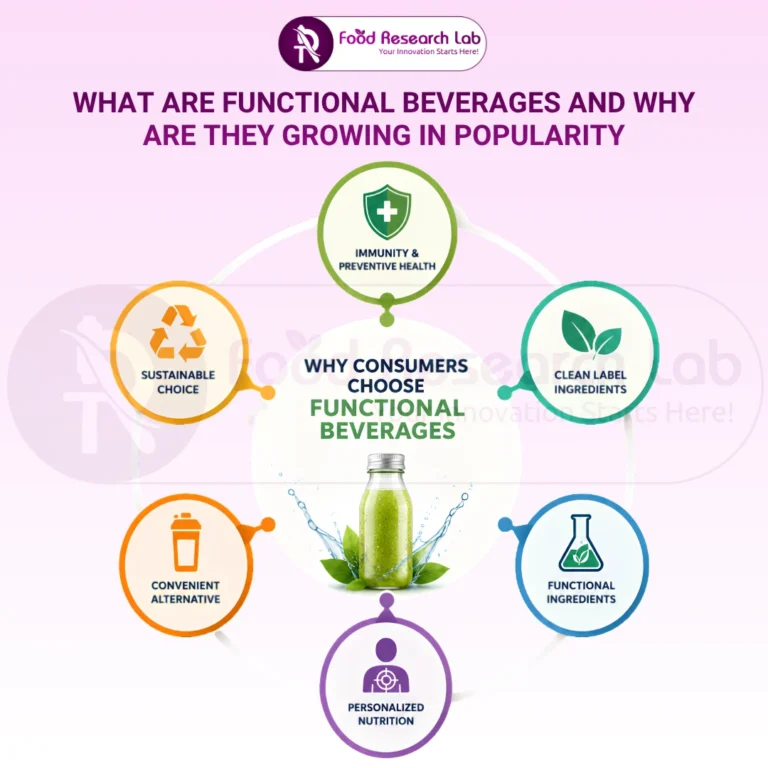
All these factors motivate beverage product manufacturers to invest into research, functional drink innovation, and production of them. As a result, competitive functional food and drink products that align with evolving consumer wellness trends. [5]
Conclusion
Functional Beverages are revolutionizing the beverages industry, as they involve the application of science and nutrition along with new consumer wellness trends. With the increase in functional beverages market growth, the key to success will be evidence-based drink formulation, consumer insights, and innovative beverage product development.
Food Research Lab provides comprehensive beverage product development services which include formulation and ingredient sourcing, pilot-scale manufacturing, shelf-life studies, regulatory services, and commercialization, helping bring innovative functional beverages to market.
Frequently Asked Question
What are Functional Beverages?
Nutrition-Focused Formulation refers to the science of choosing, balancing, and stabilizing of ingredients to make nutraceuticals that promote specific health benefits and meet consumer nutritional needs.
Why are Functional Beverages growing in popularity?
Functional Beverages are drinks developed using bioactive ingredients such as vitamins, probiotics, proteins and botanicals to provide health benefits beyond basic hydration.
What are some examples of Functional Beverages?
Some common examples are probiotic beverages, protein beverages, electrolyte beverages, adaptogenic teas, fortified juices, and energy beverages.
Are Functional Beverages regulated differently from conventional beverages?
Yes. The health claims, ingredient safety, labeling, and product formulations need to meet the food regulation and standards of the target market.
Who is the target audience for Functional Beverages?
Functional Beverages are designed for health-conscious consumers, athletes, working professionals, older adults, and individuals seeking convenient wellness solutions.
References
- Kowalska, A., Leoniak, K., & Sołowiej, B. G. (2024). Consumers’ attitudes and intentions toward functional beverages: A lesson for producers and retailers. Decision, 51, 321–337. https://doi.org/10.1007/s40622-024-00395-y
- Khalid, M. (2024). The rise of functional beverages: A revolution in the drink industry. African Journal of Food Science and Technology, 15(5), 1–3. https://doi.org/10.14303/ajfst.2024.081
- Gupta, A., Sanwal, N., Bareen, M. A., Barua, S., Sharma, N., Olatunji, O. J., Nirmal, N. P., & Sahu, J. K. (2023). Trends in functional beverages: Functional ingredients, processing technologies, stability, health benefits, and consumer perspective. Food Research International, 170, 113046. https://doi.org/10.1016/j.foodres.2023.113046
- Patria, D. G., Bernas, C. S., & Lin, J. (2025). Innovations driving the future of beverage industry. In Food Science and Nutrition. IntechOpen. https://doi.org/10.5772/intechopen.1012478
- Intrasook, J., Tsusaka, T. W., & Anal, A. K. (2024). Trends and current food safety regulations and policies for functional foods and beverages containing botanicals. Journal of Food and Drug Analysis, 32(2), 112–139. https://doi.org/10.38212/2224-6614.3499

Let’s create something Innovative and Delicious together
Food Research Lab strives for excellence in new Food, Beverage and Nutraceutical Product Research and Development by offering cutting edge scientific analysis and expertise.