Nutrition-focussed formulation can be defined as the scientific and systematic process of choosing, balancing and formulating active ingredients to create a nutritional profile with desired results. In the African nutraceutical industry, manufacturers are applying Nutrition-Focused Formulation and Advanced nutrition intelligence to develop evidence-based products that address regional nutritional needs, consumer preferences, and market demand through informed consumer and market research. [1]
How Africa's Nutraceutical Industry Applies Nutrition-Focused Formulation Insights for Advanced Nutrition Intelligence
Nutrition-focussed formulation can be defined as the scientific and systematic process of choosing, balancing and formulating active ingredients to create a nutritional profile with desired results. In the African nutraceutical industry, manufacturers are applying Nutrition-Focused Formulation and Advanced nutrition intelligence to develop evidence-based products that address regional nutritional needs, consumer preferences, and market demand through informed consumer and market research. [1]
Why Nutrition-Focused Formulation Has Become a Consumer-Driven Strategy in Africa
Africa is currently experiencing growth in the wellness industry due to reasons such as urbanization, increasing health awareness, adoption of digital health, and growth in the number of middle-income earners. By 2026, the African nutraceutical industry will be valued at about USD 13.2 billion based on preventive healthcare, functional food, dietary supplements, and online retail; South Africa and Nigeria rank first and third respectively in terms of market size and rapid growth in the market. There is currently increased use of consumer insights and Nutrition science for nutraceuticals to understand regional nutrition needs, purchasing behaviour, and health trends, enabling Functional nutrition formulation strategies tailored to African consumers.
Consumer Insight Driving Product Decisions
Recently, there has been an increase in demand for the following:
- Immune health supplements
- Gut health products
- Formulations for women’s wellness
- Nutrition for healthy aging
- Children’s nutritional supplements
- Active lifestyle and sports nutrition
This trend has led to the formulating of Dietary supplement formulation, ingredient selection, packaging, product positioning, and Custom supplement development across diverse consumer demographics in Africa. [2]
How Nutrition-focused formulation in Africa Begins with Consumer Market Intelligence
Market research is the first step in Nutraceutical product development in Africa. It involves combining retail analytics, pharmacy, e-commerce, nutrition surveys, feedback from health professionals, and demographic research to identify market opportunities before formulation begins.
Understanding Local Nutrition Needs
In Africa, the needs in terms of nutrition differ in different regions. In South Africa, there has been an increasing interest in products for healthy aging and metabolic wellness. In Nigeria, there has been increased demand for immunity and everyday health products. In Kenya, there have been increasing interests in botanical nutrition, while in North Africa, there have been interests in vitamins, minerals, and digestive health supplements. These regional differences provide valuable Product formulation insights, allowing manufacturers to design products that better reflect local dietary habits and consumer expectations.
Market Research Before Formulation
Prior to formulating new products, manufacturers typically assess:
- Nutritional gap of target populations
- Preferred format of supplements
- Consumer willingness to pay
- Scientific evidence for the use of ingredients
- Regulatory approval
- Competitive positioning
Such research will help formulate Personalized nutrition solutions and design Custom supplement development tailored to regional healthcare challenges, consumer needs, and increased market potential. [3]
Connecting Advanced Nutrition Intelligence with Formulation Decisions
Advanced nutrition intelligence is the integration of nutritional science, consumer behaviour, health data, ingredients performance, and market analysis for better formulating decisions. Rather than formulating products based on selected ingredients, companies analyze consumer insights at all stages of product development to avoid formulation risks and increase the acceptance of the products.
H3 From Consumer Data to Product Innovation
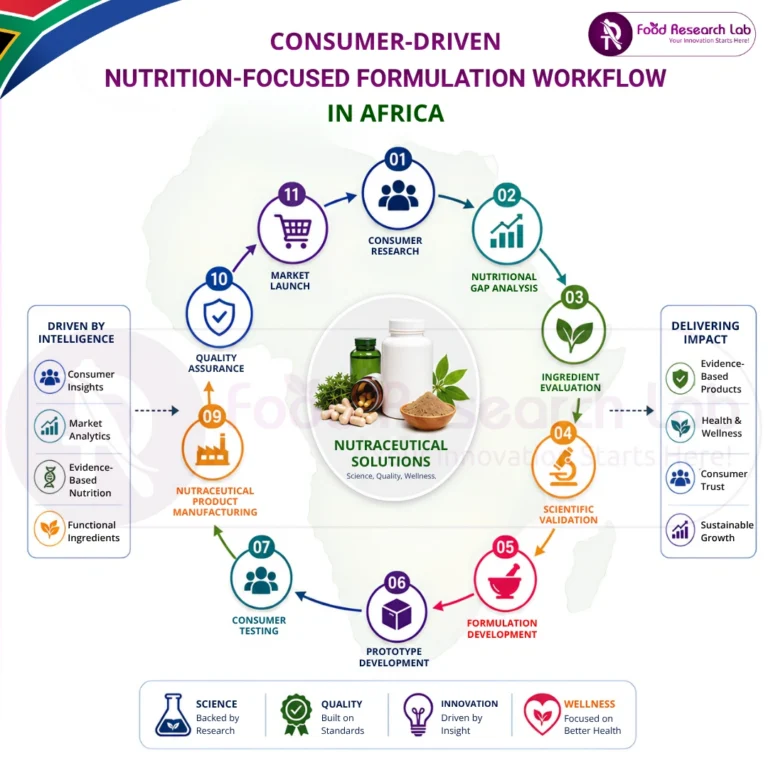
Contemporary formulation development typically proceeds according to the following steps:
Consumer Research → Nutritional Gap Analysis → Ingredient Selection → Scientific Verification → Prototype Formulation → Consumer Testing → Commercial Formulation
This methodology helps reduce unnecessary reformulations and increases the efficiency of product launches. With increased use of digital health platforms in Africa, manufacturers get useful information on dietary behaviour and wellness preferences, strengthening Nutrition optimization and supporting more effective Wellness product development.
Evidence-Based Ingredient Selection
With consumers demanding more scientific proof for nutraceutical products, formulators have started considering various criteria before selecting any ingredient than marketing claims. As a result, formulation teams evaluate several critical factors before ingredient selection, including:
- Clinical evidence from scientific literature
- The safety of the ingredient
- Bioavailability
- Maintaining stability during manufacturing processes
- Acceptability by consumers
- Supply chain reliability
The adoption of this strategy has enhanced Evidence-based nutrition while contributing to the consumer confidence and supports the development of reliable nutraceutical products. [4]
Market Trends Shaping the Future of Nutraceutical Formulation in Africa
Several trends among consumers are shaping the future of Nutraceutical formulation in Africa for 2026, where manufacturers are focusing on preventive healthcare, transparent use of ingredients, and localized product innovation.
Growing Preference for Functional Nutrition
Increasingly, African consumers perceive nutrition as a part of their long-term wellness, not a means of treatment. This preference is driving the manufacturers towards investing in the Functional food development, plant-based ingredients, probiotics, proteins, vitamins, minerals, and fiber-rich products. These categories are continuously fueling the Nutrition product innovation due to preventive healthcare and changing lifestyles of consumers.
Clean Labels and Ingredient Transparency
Consumers have become more selective about their purchases and pay more attention to high-quality ingredients and product transparency. The following factors are affecting consumers’ purchasing decisions:
- Ingredients origin
- Ingredients’ science support
- Clear product labels
- The presence of natural ingredients
- Quality of production
- Tracing of ingredients and products
That is why, manufacturers are applying the Scientific formulation methods and giving more clear descriptions of functionality of ingredients to build trust among consumers.
How Consumer Feedback Strengthens Supplement Formulation Strategies
Consumer studies continue after the release of a product onto the market. Companies use post-launch feedback to understand how well consumers accepted the product, made repurchases and liked the formula allows to improve the strategy of formulation. These insights enable continuous improvement of Supplement formulation strategies, helping manufacturers refine products while meeting changing consumer expectations.
Using Consumer Insights for Better Product Development
Leading nutraceutical manufacturers collect customer feedback through:
- Customer satisfaction Surveys
- Product reviews
- Sales at pharmacies and retail stores
- Feedback from healthcare professionals
- Social listening
- Monitoring of the product quality
The findings help manufacturers improve taste, dosage formats, ingredient combinations, packaging, and product claims while supporting consumer-focused product development. [5]
The Growing Role of Nutraceutical R&D in Consumer-Centric Innovation
Increasing competition among the African nutraceutical industry has emphasized the involvement of Nutraceutical R&D in product development. Manufacturers now combine consumer insights with scientific evaluation to support Nutraceutical product development, creating formulations that deliver measurable nutritional benefits while remaining commercially competitive.
Combining Science with Market Demand
Modern Nutraceutical R&D is nowadays taking into consideration such aspects as:
- Health needs of consumers
- Clinical and scientific evidence
- Ingredient interaction
- Nutraceutical product stability
- Nutraceutical manufacturing possibility
- Regulatory requirements
- Nutrition product differentiation
Such approach is assisting in Nutrition product innovation through integration of scientific proof with market needs.
Importance of Ingredient Efficacy Testing
Ingredients are tested prior to commercialization undergo Ingredient efficacy testing to confirm their safety, stability, compatibility, and functionality. The common tests may include the following:
- Stability during processing
- Active ingredient compatibility
- Bioavailability assessment
- Safety and quality confirmation
- Clinical evidence review
These assessments strengthen Functional ingredient development, improve product reliability, and support Nutraceutical product manufacturing by ensuring ingredient quality, stability, and regulatory compliance. [2]
Country-Specific Opportunities Across Africa
Consumers’ preferences in nutrition differ from one African nation to another depending on the health concerns in those regional health needs and market demand.
Country | Consumer & Market Trends | Formulation Focus |
South Africa | Extremely high demand for immune health, sports nutrition, digestive wellness and healthy aging. | Precision Nutrition formulation catering to specific consumers. |
Nigeria | Fast growing interest in vitamins, botanicals and children’s nutrition. | Localized Dietary supplement formulation using global and botanical ingredients. |
Kenya | Increased demand for herbal wellness and natural nutrition products. | Nutritional ingredient selection using the biodiversity and evidence-based nutrition of the region. |
Consumer Challenges Influencing Nutrition-Focused Formulation
As the market grows, manufacturers must address key consumer expectations to improve product acceptance and long-term trust.
Challenge | Consumer Expectation | Industry Response |
Building Consumer Trust | Claims that are scientific, labeling, ingredients that are traceable and quality control. | Use Scientific formulation methods and evidence-based quality standards. |
Balancing Innovation & Affordability | Effective yet affordable nutraceutical products. | Manage cost of ingredients, manufacturing process and logistics effectively while maintaining nutritional quality. |
Conclusion
The African nutraceutical industry is using the benefits of Nutrition Focused Formulations and Advanced nutrition intelligence in the creation of customer-centred products with respect to nutritional requirements and trends in the region. The use of Nutrition Science for nutraceuticals, Functional nutrition formulation and Nutraceutical R&D will help in innovating evidence-based solutions.
Food Research Lab supports nutraceutical brands with end-to-end formulation, product development, and scientific validation to accelerate successful market-ready innovations across Africa.
Frequently Asked Question
What is Nutrition-Focused Formulation?
Nutrition-Focused Formulation refers to the science of choosing, balancing, and stabilizing of ingredients to make nutraceuticals that promote specific health benefits and meet consumer nutritional needs.
Why is consumer research important in the African nutraceutical industry?
Consumer research helps manufacturers know what nutritional gaps exist, how people purchase their products, what health concerns consumers have, preferred dosage forms, and what products customers would like. These insights guide more effective formulation and product development decisions.
How does Advanced nutrition intelligence improve nutraceutical formulation?
Advanced nutrition intelligence combines consumer insights, nutrition science, market research, ingredients’ assessment, and product performance information to help formulation strategy be scientifically sound and commercially viable.
Which consumer trends are influencing nutraceutical products in Africa?
Some current trends that affect nutraceuticals in Africa include preventive healthcare, immune support, gut health, healthy ageing, botanicals, clean labels, personalized wellness, and functional nutrition.
Why is Evidence-based nutrition important?
Evidence-based nutrition is important because it ensures that the selection of the ingredients and health claims are backed by science improving product credibility, consumer confidence, and regulatory compliance.
References
- Fang, K., Liu, C., Olatunji, O. J., Suttihkana, I., & Ashaolu, T. J. (2025). Perspectives on production factors, health benefits, safety, and prospects of African fermented cereals and vegetables: A review. International Journal of Food Science and Technology, 60(1), vvae051. https://doi.org/10.1093/ijfood/vvae051
- Tura, M., Tappi, S., Valli, E., Garcia Salas, P., Suleiman, R., Thabet, C., Essaidi, I., Muyonga, J. H., Akumu, G., Bahri, W. R., Ghanem, R., Ben Souissi, J., Okoth, M. W., Thuku, L. N., Maitha, I. M., Mounir, M., Girmay, G., Gebremariam, L. W., Gebreegziabher, Z., Setti, M., & Gallina Toschi, T. (2025). A selection of African traditional and emerging foods: Processing, composition, nutritional, sensory and nutraceutical aspects. Current Research in Food Science, 11, 101112. https://doi.org/10.1016/j.crfs.2025.101112
- Oniang’o, R., Maingi, Z., Jaika, S., & Konyole, S. (2025). Africa’s contribution to global sustainable and healthy diets: A scoping review. Frontiers in Nutrition, 12, 1519248. https://doi.org/10.3389/fnut.2025.1519248
- Zahir, A., Nasiru, M. M., Maqsood, S., & Shiam, M. A. H. (2026). Health benefits of plant-based nutraceuticals: An updated review. Food and Humanity, 6, 101144. https://doi.org/10.1016/j.foohum.2026.101144
- Batta, A., Singh, S., & Prasad, A. (2026). The expanding nutraceutical market: A critical review. International Journal of Basic & Clinical Pharmacology, 15, 392–395. https://doi.org/10.18203/2319-2003.ijbcp20260444

Let’s create something Innovative and Delicious together
Food Research Lab strives for excellence in new Food, Beverage and Nutraceutical Product Research and Development by offering cutting edge scientific analysis and expertise.