The market for pet foods in Europe has undergone dynamic changes with ever-increasing demand for high quality and functional nutrition. Shelf-life stability is an increasingly significant determinant of the overall quality, consumer appeal and potential for market penetration and exportability. To maintain competitiveness in this market, a significant portion of pet food companies actively employ reverse engineering in pet nutrition, competitor benchmarking pet food, pet food formulation analysis and analytical testing for pet food to identify leaders and enhance their product development and marketing efforts. [1]
How EU's Pet Food Brands in the Pet Nutrition Segment Use Reverse engineering to Benchmark Shelf-Life and Stability Versus Competitors
The market for pet foods in Europe has undergone dynamic changes with ever-increasing demand for high quality and functional nutrition. Shelf-life stability is an increasingly significant determinant of the overall quality, consumer appeal and potential for market penetration and exportability. To maintain competitiveness in this market, a significant portion of pet food companies actively employ reverse engineering in pet nutrition, competitor benchmarking pet food, pet food formulation analysis and analytical testing for pet food to identify leaders and enhance their product development and marketing efforts. [1]
What is Reverse Engineering in pet nutrition?
Reverse engineering in pet nutrition involves analysing pet food formulations, processing, preservation, packaging, and shelf-life stability of competing products. This includes not only examining the product ingredients but also identifying using bioavailability assessment methods their moisture stability, microbial safety, oxidation control, package barrier properties and nutrient losses to learn the reasons behind better performing products so they can inform improvements, particularly for custom pet food formulation. It is a competitive analysis process to foster innovation and commercialisation of your new pet product.
Market Insights That Are Shaping the Benchmarking of Shelf Life in Europe
Premiumization Leads to Need for Increased Stability
The preference of consumers for premium or functional foods with omega-3, probiotic content, botanicals, and specialty proteins makes stability critical. Pet food shelf-life benchmarking is vital in maintaining product quality and differentiation. [2]
E-commerce Has Extended Supply Chains
Increase in e-commerce increases exposure to extended logistics and storage. Firms need to ensure pet food storage stability benchmarking for maintenance of freshness.
Functional Nutrition Trend Is Increasing
Products that enhance digestive, immune, cognitive, mobility, and senior well-being functions grow rapidly. Effectiveness of such products is dependent on their stability.
Environmental Sustainability Affects Packaging Innovation
Consumers are demanding sustainable packaging. Firms need to balance between environmental requirements and shelf-life through innovative pet food preservation methods and packaging technology.
Consumer Expectations are Spurring Demand for More Durable and Clean Formulations of Pet Nutrition Products
Product Quality and Safety Remains an Important Criterion
Pet owners want stable quality of their products during whole shelf-life period. Spoilage, oxidation, deterioration of nutrients, texture modifications may damage company’s reputation. That is why companies conduct stability studies and pet nutrition product testing.
Purchasing Habits Impact Storage Needs
The growth of bulk and online purchases made it necessary to focus on long-term stability. This trend affects pet food R&D strategies and stimulates better quality preservation and stability in formulations. [3]
Main Market Trends Defining Shelf-Life Innovations in Europe
Trend | Description |
Natural Preservation Technologies | Mixed tocopherols, rosemary extracts, plant antioxidants support clean label while maintaining integrity (pet food preservation methods) |
Advanced Packaging Solutions | High-barrier materials, oxygen scavengers, moisture-control, modified atmosphere enhance pet food storage stability, extend shelf life |
Functional Ingredient Protection | Technologies protecting probiotics, omega fatty acids, vitamins support shelf-life optimization pet food, preserve health benefits |
Cross-Border Distribution Growth | Expanding exports require quality maintenance across diverse climates. Stability validation, packaging innovations increasingly important |
How Reverse Engineering Assists EU Product Developers in Unravelling Competitor Shelf-Life Performance
Addition to Ingredients Evaluation
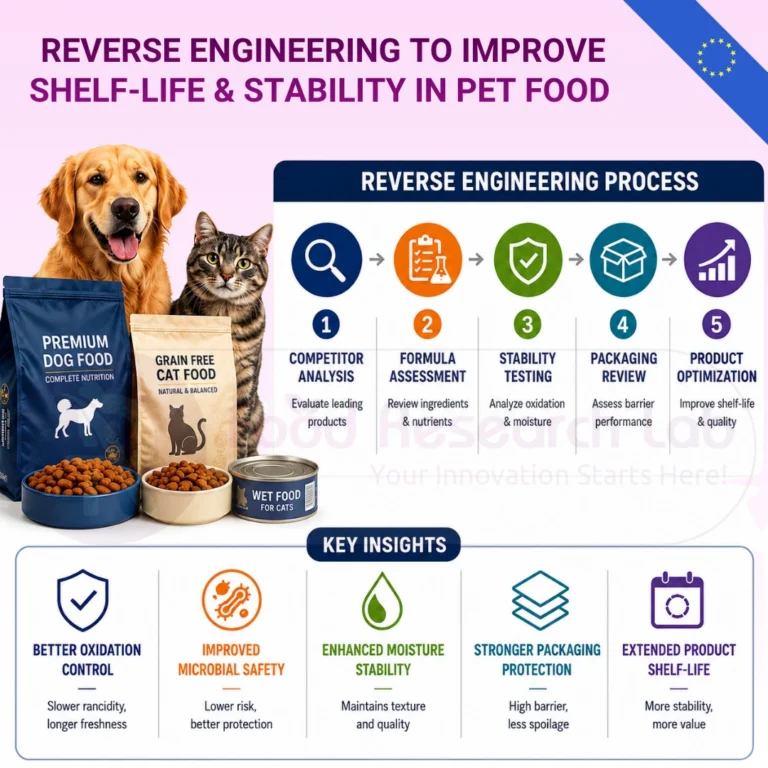
Reverse engineering in pet Nutrition are analysed with respect to formulation design, stabilization, packaging, dry and wet food processing parameters. Comprehensive analysis identifies superior shelf-life performance factors.
Methods Used in Stability Benchmarking
Typical methods include oxidation profile analysis, moisture transfer, water activity, accelerated shelf-life testing, packaging barrier analysis, nutrient stability assessment, microbial testing. These are used for pet nutrition stability analysis, analytical testing for pet food, pet food quality benchmarking, and finding improvement areas.
Innovative Shelf-Life Development Approaches
European companies use natural antioxidants, moisture management, high-barrier packaging, modified atmosphere, and functional ingredients stabilization. This increases stability as well as sustainability and future pet food product development. [4]
Applications of Competitive Benchmarking in the European Pet Food Industry
Table 1: Competitive Benchmarking Data through Reverse Engineering
EU Product Category | Reverse Engineering Focus | Shelf-Life Insight | Product Development Outcome |
Premium Dry Dog Food | Antioxidant systems | Improved oxidation resistance | Extended freshness |
Wet Cat Food | Retort processing | Enhanced microbial stability | Better nutrient retention |
Functional Pet Treats | Moisture-control systems | Reduced texture degradation | Improved consistency |
Senior Pet Nutrition | Packaging barrier performance | Lower nutrient loss | Enhanced functional claims |
The above studies help in establishing pet food shelf-life benchmarking, pet food processing experiments, and pet food pilot runs prior to production.
Strategic Opportunities arising from Competitive Shelf-Life Benchmarking
White Space Opportunities
Benchmarking often uncovers opportunities in natural preservative systems, sustainable packaging systems, functional nutritional foods, premium export formulas, and special pet supplements.
Product Development Focus Areas
The knowledge gained through benchmarking of competitors will be valuable in determining how best to choose ingredients, preserve products, package, process and stabilize nutritionally. The information will be useful in custom pet food formulation and product development for pet food.
Commercialization Strengths
Superior shelf-life performance helps with enhanced retail acceptance, reduced returns, improved inventory control, and increased exports. Shelf-life improvements will improve consumer confidence and brand reputation. [5]
Regulatory and Market Access Strengths
Scientific backing helps ensure EU pet food compliance, claim substantiation and pet food regulatory initiatives for premium pet food products.
Case Study for FRL: Reverse Engineering Competitor Shelf-Life Performance
Client Challenge
A European pet food manufacturer approached Food Research Lab after facing shelf-life issues in its premium pet nutrition product. The product showed early oxidation and loss of freshness during storage, affecting product quality and customer satisfaction.
FRL’s Reverse Engineering Approach
FRL conducted competitor benchmarking pet food studies by evaluating competitor formulations, antioxidant systems, moisture control strategies, packaging performance, and processing conditions. The assessment included pet nutrition stability analysis, oxidation testing, and packaging barrier evaluation.
Key Findings
The benchmark products demonstrated better shelf-life performance using mixed tocopherols, optimized water activity levels, and high-barrier packaging that minimized oxygen exposure and nutrient degradation.
Outcome
Based on the findings, FRL recommended improvements in antioxidant selection, moisture management, and packaging design. Validation through pilot trials and stability studies resulted in improved product stability, extended shelf life, and enhanced product quality for the client.
Conclusion
The shelf-life performance has now become an important competitive parameter for Europe’s pet food nutrition industry. This can be achieved through reverse engineering in pet food nutrition, pet nutrition stability analysis and pet food shelf-life benchmarking. In addition to that, when combined with packaging evaluation and scientific validation, it helps in enhancing pet food product development, commercialization, and success in the European market during 2025-2026.
Food Research Lab provides pet food product development services to custom formulation, processing trials, pilot production, regulatory support and innovation for pet foods worldwide.
Frequently Asked Question
It involves analysing competitor products to understand their formulation, processing, packaging, preservation, and shelf-life performance.
It helps improve product quality, stability, competitiveness, and overall market performance.
Common tests include oxidation testing, water activity analysis, moisture testing, microbiological assessment, and packaging evaluation.
Packaging protects pet food from oxygen, moisture, light, and other factors that can reduce product quality and shelf life.
It helps identify improvement opportunities, reduce development risks, and support product innovation and commercialization.
References
- Jobe, M. T., & Downs, K. M. (2025). Systematic Review and Meta-Analysis of Quality Claims Associated with Fresh Pet Food: Evaluating Scientific Evidence for Additives, Ingredient Quality, and Effects of Processing in Pet Nutrition. Animals : an open access journal from MDPI, 16(1), 41. https://doi.org/10.3390/ani16010041
- Antonina Sparacino, Giulia Mastromonaco, Valentina Maria Merlino, Danielle Borra, Simone Blanc, How do pet food companies communicate sustainability practices on their websites?, Environmental Challenges, Volume 19, 2025, 101154, ISSN 2667-0100, https://doi.org/10.1016/j.envc.2025.101154. (https://www.sciencedirect.com/science/article/pii/S2667010025000733)
- Ai, C., Akaichi, F., Glenk, K., Revoredo-Giha, C., & Costa-Font, M. (2025). What Drives Pet Food Choices? A Systematic Literature Review. Animals, 15(22), 3235. https://doi.org/10.3390/ani15223235
- David Blumenthal, Marion Schvartz, Valérie Guénard Lampron, Marine Masson, Sensory reverse engineering: A framework for sustainable product development used on vegan chocolate mousse, Food Quality and Preference, Volume 133, 2025, 105614, ISSN 0950-3293, https://doi.org/10.1016/j.foodqual.2025.105614. (https://www.sciencedirect.com/science/article/pii/S0950329325001892)
- Neha Saxena, Mitali Sarkar, Biswajit Sarkar, Which retail strategy for shelf life products can satisfy consumers under game policy?, Journal of Retailing and Consumer Services, Volume 76, 2024, 103595, ISSN 0969-6989, https://doi.org/10.1016/j.jretconser.2023.103595. (https://www.sciencedirect.com/science/article/pii/S0969698923003466)

Let’s create something Innovative and Delicious together
Food Research Lab strives for excellence in new Food, Beverage and Nutraceutical Product Research and Development by offering cutting edge scientific analysis and expertise.