Formulating a retort processed functional beverage is difficult since heat sterilization will influence the stability of the ingredients in terms of stability, flavor, texture, and shelf-life performance. retort-processed beverage reverse engineering evaluates the commercially produced retort beverages to understand how the formulation, functionality of ingredients, heat-processing, packaging compatibility, and shelf-life performance of the beverages are made. By combining analytical chemistry and food engineering for the improvement of functional beverage formulation and optimization of process to help with product development. In 2026, the formulation assistance from AI, predictive shelf-life modeling, and analytical technology are making the retort process optimization and commercial-scale production while maintaining product quality, safety, and commercial sterility. [1]
Reverse Engineering Retort-Processed Functional Beverages
Formulating a retort processed functional beverage is difficult since heat sterilization will influence the stability of the ingredients in terms of stability, flavor, texture, and shelf-life performance. retort-processed beverage reverse engineering evaluates the commercially produced retort beverages to understand how the formulation, functionality of ingredients, heat-processing, packaging compatibility, and shelf-life performance of the beverages are made. By combining analytical chemistry and food engineering for the improvement of functional beverage formulation and optimization of process to help with product development. In 2026, the formulation assistance from AI, predictive shelf-life modeling, and analytical technology are making the retort process optimization and commercial-scale production while maintaining product quality, safety, and commercial sterility. [1]
Ingredient Stability & Process Optimization for Retort Products
Retort processing involves the use of temperatures of 115°C–135°C under pressure for achieving commercial sterility. While this achieves commercial sterility by killing the pathogenic and spoilage bacteria, it also influences the stability of many heat-labile functional ingredients. Hence, retort beverage formula must balance microbial safety with ingredient stability, sensory quality, nutritional value, and shelf-life performance.
Functional Ingredient Stability During Thermal Processing
Each functional ingredient has its own unique reaction respond to thermal processing, hence the importance of studying ingredient behaviour in functional drink formulation analysis. The effects of heat include:
- Oxidation of vitamin C and nutrient depletion
- Morphological changes of polyphenols and reduced antioxidant effect
- Loss of volatile compounds in botanical extracts
- Protein denaturation, aggregation, or sedimentation
- In-stability of emulsifiers during thermal cycles
- Fading or degradation of natural colours
As compared to ingredient identification, functional beverage reverse engineering evaluates how the ingredients interact under commercial retort conditions. Analytical tools like chromatography, spectroscopy, rheology, particle size determination, and nutrition analysis can be used to establish whether the ingredient degradation results from too much heat, oxygen, change in pH, formulation, or package interaction.
As a part of formulation validation procedure manufacturers perform ingredient stability testing. Stability testing includes both accelerated and real-time shelf-life stability studies that involve monitoring changes in vitamins, antioxidants, proteins, flavor, color, pH, viscosity and bioactivity during processing and storage, ensuring the beverage meets quality, safety, and commercial performance requirements. [2]
How Reverse Engineering Supports Functional Beverage Development
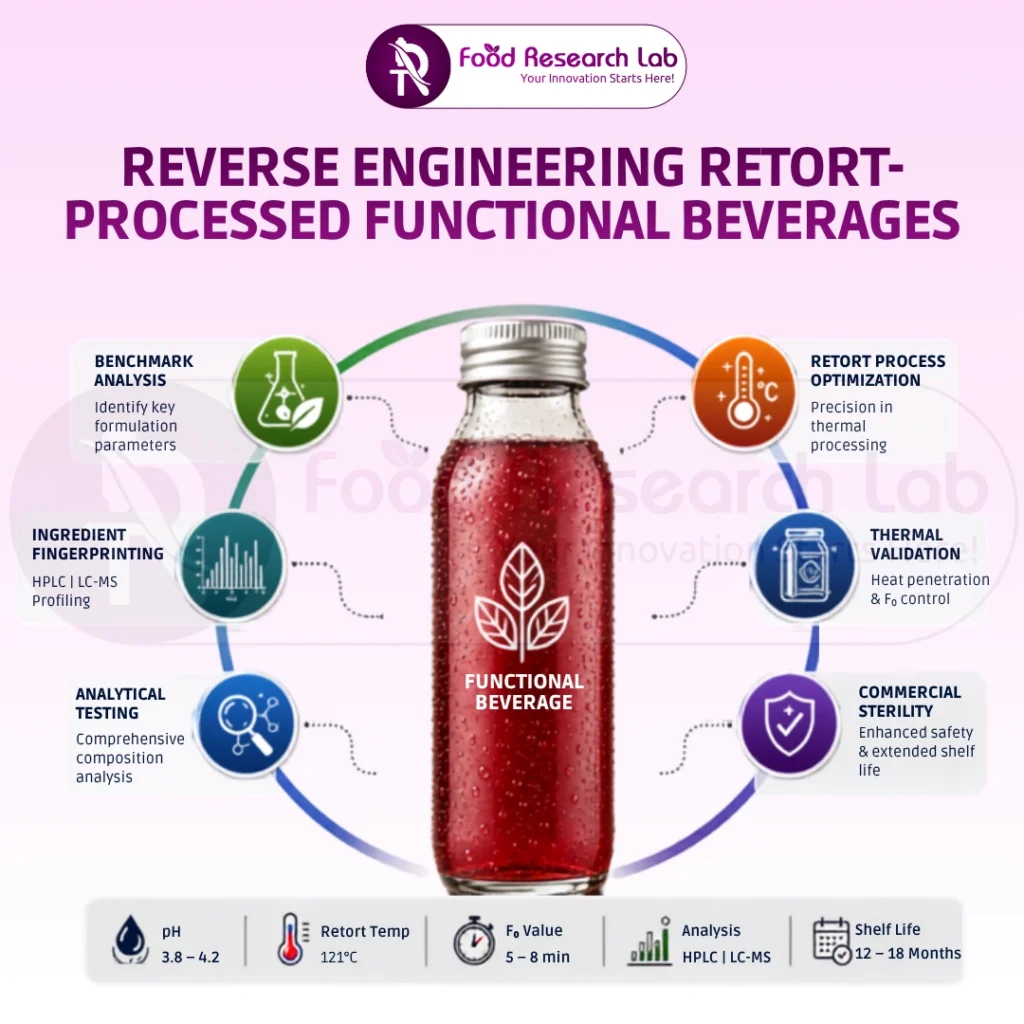
Reverse engineering is the use of the analytical results to formulate the optimized product to be used in manufacturing. This is done through benchmarking of an existing commercial beverage; followed by characterization, analytical testing, thermal process and formulation optimization. This scientific procedure enables manufacturers to enhance the stability of the ingredients, retort process optimization, reduce formulation risk, and accelerate beverage product development while maintaining product quality and commercial sterility.
Key Formulation and Retort Processing Parameters
A functional beverage formulation requires not only the optimal selection of ingredients but also an optimized retort processing condition. The following parameters are considered when conducting retort process optimization to obtain a safe, high-quality and commercially stable beverage. [3]
Parameter | Typical Range / Consideration | Purpose |
pH | 3.5-4.6 (acidified drinks) | Assists in ensuring microbial safety and ingredient stability. |
Soluble Solids (°Brix) | 6-15 °Brix | Influences sweetness, viscosity, and heat transfer. |
Viscosity | Product-specific | Affects heat penetration, mouthfeel, filling characteristics. |
Process Temperature | 115–135°C | Achieves commercial sterility while decreasing the degradation of ingredients. |
F₀ Value | Typically, 3–12 min* | Ensures adequate microbial lethality during retort processing. |
Cooling & Headspace Oxygen | Rapid cooling with minimal oxygen | Reduces oxidation and preserves flavour, colour, and nutrients. |
Packaging Compatibility | Retort-compatible bottles, cans, or pouches | Maintains package integrity during thermal processing. |
*Note: The F₀ value will vary from one beverage formulation, pH, package size and target microorganisms and applicable regulatory requirements.
Recent Technologies Transforming Retort-Processed Beverage Reverse Engineering (2026)
Advances in retort processing R&D are assisting in the development of functional beverages through better stability of ingredients, process efficiencies, and commercial scalability.
Artificial Intelligence Assisted Formulation
AI and machine learning assist in predicting interactions between ingredients and degradation of heat sensitive ingredients such as vitamins, polyphenols, proteins and plant extracts. This allows for faster optimization of formulations while reducing laboratory trials.
Digital Twin Process Simulations
The digital twins allow simulation of heat penetration, packaging and behavior of ingredients during retort processing to optimize F₀ values and processing cycle times prior to pilot production runs.
Advanced Analytical Testing
Advanced technologies like HPLC, LC-MS and spectroscopic methods allow quick assessment of bioactive retention, flavor compounds, and formulation consistency to allow for commercial beverage scale-up and faster beverage commercialization.
Sustainable Processing Technologies
Modern retort processing technologies use energy efficient heating, heat recovery, and sustainable retort compatible packaging to minimize nutrient loss, reduce energy consumption, and improve production sustainability. [4]
Functional Beverage Products Suitable for Retort Processing
Retort processing is widely used to manufacture shelf- stable functional beverages, ensuring product safety and shelf-life extension. The table below highlights common beverage categories, their functional ingredients, and the key focus areas during reverse engineering and formulation optimization. [5]
Beverage Category | Functional Ingredients | Reverse Engineering Focus |
Protein Beverages | Whey, Soy, Pea Protein | Protein stability, sedimentation, viscosity |
Botanical Beverages | Herbal extracts, adaptogens | Bioactive retention, flavour stability |
Nutritional Beverages | Vitamins, minerals | Nutrient stability, thermal degradation |
Plant-Based Drinks | Oat, almond, coconut | Emulsion stability, phase separation |
Sports & Recovery Drinks | Electrolytes, amino acids | Ingredient compatibility, shelf-life |
Functional Dairy Beverages | Milk proteins, probiotics* | Heat stability, compatibility of packaging materials |
*Probiotic viability depends on the processing strategy and formulation.
Case Study: Reverse Engineering a Retort-Processed Functional Beverage
Client:
A beverage manufacturer approached Food Research Lab to provide technical assistance on formulating a shelf-stable beverage containing botanical ingredients due to instability of the product during commercial retort processing.
Challenge:
The beverage was unstable because of polyphenolic degradation, loss of colour, flavour degradation, protein instability, and poor consistency in product quality because of thermal sterilization, limiting its target shelf life.
FRL Solution:
Using retort-processed beverage reverse engineering technique, the product was benchmarked, HPLC analysis of the bioactive was done and factors such as pH (3.8-4.2), soluble solids (8-10 ° Brix), viscosity, and thermal process lethality (F₀ target: 5-8 minutes) were considered. The team optimized the retort profile (121°C), formulation composition, oxygen control, and retort-compatible packaging to improve ingredient stability and process consistency.
Outcome:
An optimized beverage that showed improvement in retention of bioactives, colour and flavour stability, commercial sterility, and batch-to-batch consistency, providing a technically validated formulation suitable for pilot-scale production and commercial beverage development.
Regulatory and Quality Considerations
Commercial retort processed functional beverages should meet relevant food safety, labelling and functional claim regulations of the markets where they are intended for distribution. In different regions, manufacturers may be obliged to adhere to FSSAI, US FDA (21 CFR), EFSA, Codex Alimentarius and other national food regulatory bodies. Regulation compliance can be achieved by means of validated thermal processing, commercial sterility test, shelf-life studies, correct labelling of ingredients and nutrients, and quality management systems like HACCP, GMP and ISO 22000. These measures help ensure product safety, regulatory compliance, and consistent commercial quality. [2]
Conclusion
Retort-processed beverage reverse engineering helps manufacturers to create optimize functional beverage formulation, ingredient stability and thermal processing to obtain safe, high-quality and commercially feasible products. Due to the rapid advancements in beverage formulation driven by AI technologies and analytics in 2026, reverse engineering is accelerating the development of stable, scalable functional beverages.
Looking to develop or optimize your next functional beverage? Food Research Lab we offer end-to-end beverage development services, including reverse engineering, formulation, retort process optimization, stability studies, pilot scale validation and regulatory assistance to help bring innovative beverages to market with confidence.
Frequently Asked Question
What is Retort-Processed Beverage Reverse Engineering?
It is the scientific process of evaluating commercially produced retort beverages to determine the formulations, functionality of ingredients, thermal processing conditions, packaging compatibility and shelf-life performance for product improvement or commercialization.
Why is retort processing challenging for functional beverages?
High-temperature sterilization can affect the stability of vitamins, proteins, botanicals extracts, flavor, color and texture, making optimized formulation and process control essential.
How does reverse engineering support beverage product development?
It helps in identifying formulation and processing issues ahead of time, optimizing the ingredient stability, improving the retort process and reducing development risks before commercializing.
Which beverage products commonly use retort processing?
Retort processing is widely used for shelf stable functional beverages, protein beverages, nutritional beverages, plant-based beverages, soups, sauces and ready to drink products
How long does reverse engineering a retort beverage typically take?
The timeline depends on formulation complexity, analytical testing, and validation requirements, but most projects are completed within several weeks to a few months.
References
- Jimenez, P. S., Bangar, S. P., Suffern, M., & Whiteside, W. S. (2023). Understanding retort processing: A review. Food Science & Nutrition, 12(3), 1545–1563. https://doi.org/10.1002/fsn3.3912
- Akdemir Evrendilek, G. (2026). Designing functional foods beyond bioactivity: Integrating processing, safety, and regulatory readiness. Applied Sciences, 16(6), 2999. https://doi.org/10.3390/app16062999
- Jimenez, P. S., Bangar, S. P., Suffern, M., & Whiteside, W. S. (2024). Understanding retort processing: A review. Food Science & Nutrition, 12, 1545–1563. https://doi.org/10.1002/fsn3.3912
- Hussein, J. B., Workneh, T. S., Kassim, A., et al. (2026). Exploring trends and future developments in the application of artificial intelligence in food processing and preservation. Food Engineering Reviews, 18, 16. https://doi.org/10.1007/s12393-026-09445-w
- Arroyo-Moreno, S., Saiz-Gonzalo, G., O’Connell, O., Joy, S., Carroll, L., Moran, B., McSweeney, S., & Bleiel, S. B. (2026). Enumeration of heat-treated probiotics in functional beverages. Journal of AOAC INTERNATIONAL, qsag024. https://doi.org/10.1093/jaoacint/qsag024

Let’s create something Innovative and Delicious together
Food Research Lab strives for excellence in new Food, Beverage and Nutraceutical Product Research and Development by offering cutting edge scientific analysis and expertise.