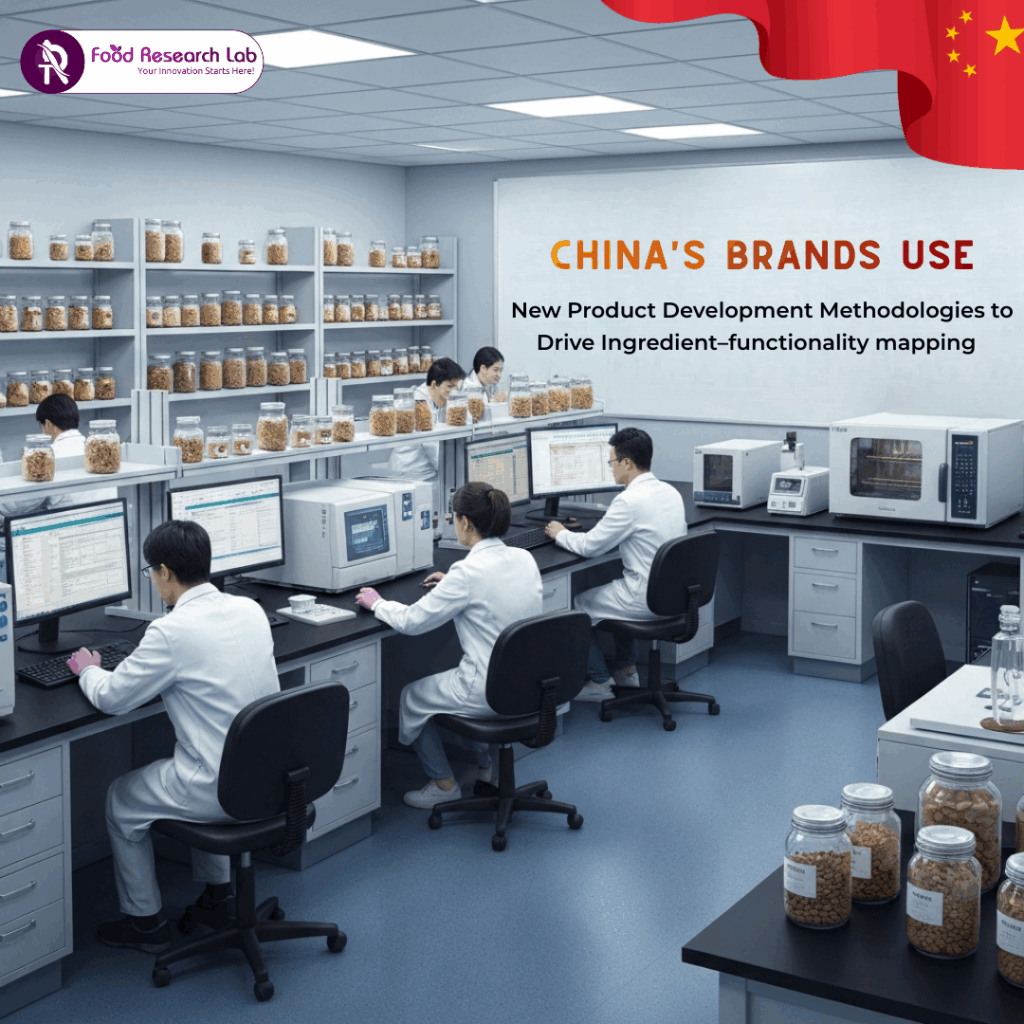
China’s brands drive ingredient-functionality mapping through agile new product development (NPD), leveraging rapid ideation, consumer insights, digital ecosystems, and strong supply chains to quickly translate raw ingredient data into tailored, functional product benefits. They use fast prototyping and iterative testing, often involving government-supported innovation clusters, to rapidly match active ingredients with specific market needs and consumer demands.
This ingredient–functionality mapping helps the brand to integrate ingredients to measurable functional and clean-label outcomes early in formulation. This science-driven approach supports efficient development across food products, beverages, beauty, and nutraceuticals, while ensuring safety and regulatory readiness. It also enables smoother alignment with global standards, allowing a new product development strategy in China to scale internationally without reformulation.[1]
The ingredient–functionality mapping involves the analysis of the role, bioactive components, mechanisms of action, and effective dosage of each ingredient while ensuring sensory and regulatory alignment. It is a core part of ingredient research and analysis, gaining momentum in China as consumers increasingly expect transparency and scientifically supported health benefits. To meet this demand, brands are combining traditional knowledge with modern research methods, enabling evidence-based validation. This integrated approach supports compliant new product development across industries. [2]
Beauty and wellness brands in China show that the new product development (NPD) is changing using modern digital technologies. These brands rely more on data from e-commerce platforms along with AI-based ingredient analysis to understand what consumers want and predict functional benefits. This helps in designing targeted formulations. The insights then go into digital R&D systems, where digital twins, robotic formulation, and automated testing connect formulation design with scale-up and manufacturing. By connecting consumer data, formulation intelligence, and production workflows, companies improve product consistency, reduce launch risks, and strengthen the new product development process (NPD) in China.
This visual (fig. 1) summarizes how digital intelligence supports modern product development in China, showing the flow from consumer data to formulation design and manufacturing through integrated digital systems.
Recent digital technologies in China translate consumer insights and ingredient intelligence into actionable development strategies. The following table explains the modern NPD methods that connect ingredient–functionality mapping with scientific validation, rapid prototyping, and cross-industry collaboration. Together, these approaches demonstrate how integrated digital systems strengthen product performance, compliance, and speed-to-market in China’s beauty and wellness sectors.[3]
Modern NPD Method | Ingredient–Function Mapping Approach | Benefits / Outcomes | Chinese Industry Examples |
Agile & Rapid Prototyping | Rapid formulation cycles link ingredient changes to functional outcomes using real-time feedback | Faster iteration, trend responsiveness, shorter time-to-market | Nongfu Spring (botanical beverages), Winona (sensitive-skin formulations), functional gummy brands |
Stage-Gate with Scientific Validation | Clinical, stability, safety, and regulatory checkpoints validate ingredient functionality | Regulatory compliance, scientific credibility, validated claims | By-Health (probiotic validation), Mengniu & PepsiCo China (reduced-sugar beverages), Inoherb (TCM ingredient traceability) |
Cross-Industry Co-Development | Shared ingredient research across food, beauty, pharma, and TCM sectors | Multi-category innovation, shared R&D efficiency, faster ingredient development | Tongrentang (TCM-based drinks), Bloomage Biotech (hyaluronic acid), peptide-based nutrition and skincare |
Chinese brands apply ingredient functionality mapping (IFM) with modern NPD methods across different industries by linking key functional ingredients to their intended benefits and representative brand examples. The following table explains how these ingredient–benefit relationships influence product effectiveness, user acceptance, and treatment adherence across the formulation of herbal products, food, and cosmetic development. [4]
Industry / Category | Functional Ingredients & Mapped Benefits | How IFM is Applied | Brand Examples | Key Outcomes |
Food & Beverage | • Sweeteners → reduced-calorie sweetness | Rapid NPD, consumer feedback, function-driven ingredient pairing | Genki Forest, Nongfu Spring, Chi Forest | Clean-label, functional beverages with global taste and compliance standards |
Beauty & Personal Care | • Ceramides → barrier repair • Hyaluronic acid → hydration • Bakuchiol → retinol-like anti-aging • Probiotics → microbiome balance | Clinical testing, instrumental efficacy measurement, sensory correlation | Winona, Proya, Florasis | Scientifically validated products meeting global efficacy expectations |
Nutraceuticals & Health Supplements | • Peptides → muscle recovery • Omega-3 → cognitive support | Dosage thresholds, bioavailability mapping, synergy testing | Multiple supplement brands | Products aligned with EU, US, and ASEAN regulatory standards, measurable functional benefits |
Herbal Ingredients | • Ginseng → immunity & energy • Goji → antioxidants & wellness • Astragalus → immune support | Bioactivity testing, dosage optimization, synergy mapping | Tongrentang, Genki Forest (herbal drinks) | Measurable health benefits, traditional herbs integrated into modern formulations |
From the ingredient–functionality mapping approach discussed above, Chinese brands draw on Traditional Chinese Medicine (TCM) wisdom to integrate classical herbal properties with modern ingredient research and analysis methods. This process includes identifying and standardising bioactive compounds (e.g., ginsenosides in ginseng) and validating mechanisms of action through laboratory or clinical studies, while following international regulatory standards for innovation for product approval in China. By combining traditional knowledge with scientific validation, these brands develop differentiated, evidence-backed wellness products positioned for global markets.[5]
Regulatory Alignment:
Chinese brands align products with domestic regulations (NMPA, SAMR, GB standards) and international frameworks (FDA, EFSA, ASEAN) through dosage control, safety assessment, and compliant health claims, enabling export readiness and risk reduction.
Traceability & Transparency:
Digital traceability systems, including QR codes and blockchain, track ingredients from source to finished development of food products, supporting authenticity, safety, and global audit requirements.
Sensory & Consumer Acceptance:
Sensory testing ensures taste, texture, aroma, and stability are maintained while incorporating functional ingredients, supporting claim credibility and global market appeal.
Integrated Approach:
By integrating compliance, traceability, and sensory validation, Chinese brands meet global quality standards, access EU, US, and ASEAN markets, and maintain consumer trust.
China’s rapid innovation demonstrates how Ingredient–Functionality Mapping (IFM) and modern NPD models convert ingredients into globally compliant, high-value functional products through scientific validation, clean-label design, digital R&D, and regulatory alignment. Food Research Lab enables brands to achieve similar outcomes with expert IFM analysis, advanced formulation, rapid prototyping, and full regulatory support—delivering stable, great-tasting, globally ready food product development, beverages, supplements, and the development of cosmetics products from our state-of-the-art lab.
Food Research Lab strives for excellence in new Food, Beverage and Nutraceutical Product Research and Development by offering cutting edge scientific analysis and expertise.