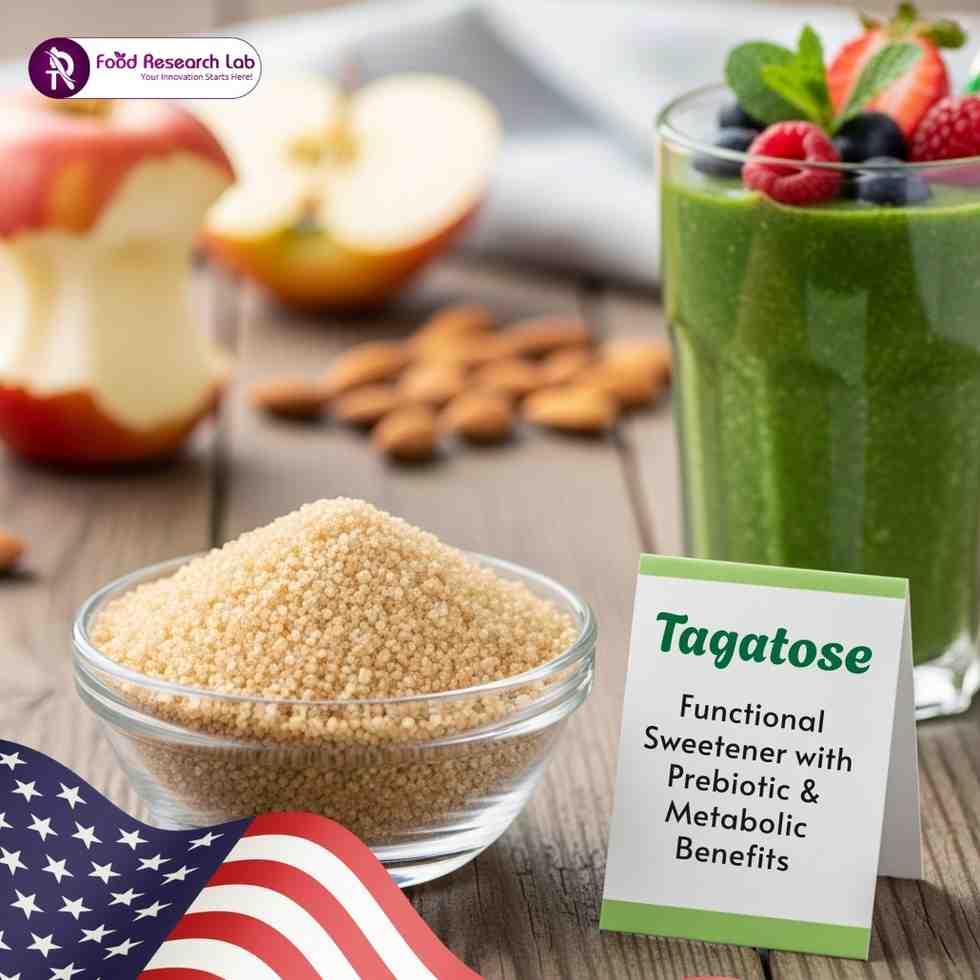
Tagatose is a naturally occurring monosaccharide classified as a rare sugar tagatose, gaining strong interest as a functional tagatose sweetener, low-calorie tagatose sweetener in food and beverage formulation. Tagatose sweeteners deliver approximately 90% of sucrose’s sweetness with 60% low calories sweetener tagatose, has a low glycaemic sweetener index that helps prevent blood glucose spikes, and closely mimics sucrose’s functional properties across applications. Naturally present in small amounts in dairy products and fruits and produced commercially through enzymatic conversion, tagatose is also Ketogenic Certified, Non-GMO Project Verified, and Plant-Based Certified, making it a versatile solution for manufacturers seeking clean-label, low-calorie sweetener, and gut-health-supporting tagatose sweetener systems without compromising taste or processing efficiency. [1] [2]
Understanding Tagatose: A Next-Generation Functional Sweetener with Prebiotic and Metabolic Benefits
Tagatose is a naturally occurring monosaccharide classified as a rare sugar tagatose, gaining strong interest as a functional tagatose sweetener, low-calorie tagatose sweetener in food and beverage formulation. Tagatose sweeteners deliver approximately 90% of sucrose’s sweetness with 60% low calories sweetener tagatose, has a low glycaemic sweetener index that helps prevent blood glucose spikes, and closely mimics sucrose’s functional properties across applications. Naturally present in small amounts in dairy products and fruits and produced commercially through enzymatic conversion, tagatose is also Ketogenic Certified, Non-GMO Project Verified, and Plant-Based Certified, making it a versatile solution for manufacturers seeking clean-label, low-calorie sweetener, and gut-health-supporting tagatose sweetener systems without compromising taste or processing efficiency. [1] [2]
Nutritional and Metabolic Properties of Tagatose:
This table summarizes the key nutritional, metabolic, and functional attributes of tagatose sweetener that make it a preferred next-generation sweetener for health-focused food and custom supplement formulations.
Feature | Details |
Sweetness Intensity | ~90% as sweet as sucrose, allowing near one-to-one sugar replacement without taste compromise |
Caloric Value | Tagatose Provides ~60% low calories sweetener than sucrose, supporting low-calorie and reduced-energy formulations |
Glycaemic Index (GI) | Very low GI (~3); does not cause rapid blood glucose elevation |
Glycaemic Response | Minimal impact on blood glucose levels, making it suitable for blood sugar management |
Insulin Response | Does not significantly stimulate insulin secretion, supporting metabolic health |
Suitability for Diets | Appropriate for diabetic, low-glycaemic, ketogenic, and weight-management diets |
Functional Benefits | Acts as a prebiotic by nourishing beneficial gut bacteria; maintains sugar-like taste and texture |
Certifications | NutraStrong™ Prebiotic Verified, Ketogenic Certified, Non-GMO Project Verified, Plant-Based Certified |
Market Relevance | Aligns with growing consumer demand for functional sweetener tagatose, gut-health-supporting tagatose, lower-calorie sweeteners |
Tagatose: Prebiotic Potential and Gut Health Benefits:
- Prebiotic mechanism: Tagatose sweeteners is poorly digested in the small intestine and reaches the colon intact, where it acts as a food source for beneficial gut bacteria.
- Gut fermentation: It is selectively fermented by beneficial microbes such as Bifidobacterium and Lactobacillus, producing short-chain fatty acids (SCFAs). [3]
- Digestive health support: SCFAs help improve gut barrier function, reduce inflammation, and support overall digestive health.
- Microbiome balance: Tagatose sweeteners promote the growth of beneficial bacteria while limiting harmful microbial activity.
- Metabolic link: Fermentation of tagatose supports GLP-1 release, helping improve blood sugar control and insulin sensitivity.
- Gentle on the gut: Compared to many traditional prebiotics, tagatose ferments slowly, reducing bloating and gastrointestinal discomfort.
- Compared to traditional prebiotics: Unlike inulin or FOS, tagatose provides prebiotic benefits and sweetness, with low calories sweetener and a low glycaemic sweetness impact.
- Formulation advantage: Combines gut health support with good taste and texture, making it ideal for functional foods and beverages.
Clinical Study Overview: Effects of Tagatose on Glycaemic Response and Gut Microbiota:
This table outlines the design, objectives, and key outcomes of a 2025 human clinical trial evaluating tagatose’s prebiotic potential and its effects on low glycaemic control and metabolic health of Tagatose. [4]
Category | Details |
Study Title | Effects of Tagatose on Glycaemic Response and Gut Microbiota |
Sponsor | PepsiCo Global R&D |
Study Type | Double-blind, randomized, controlled, cross-over clinical trial |
Study Period | March 25, 2025 – December 31, 2025 |
Participants | 55 healthy adults (18–50 years) with impaired fasting glucose and/or hyperinsulinemia |
BMI Range | 20.0–34.9 kg/m² |
Groups | Tagatose (10 g/day) vs. Placebo (sucrose, 10 g/day) |
Duration | 4 weeks per intervention |
Primary Objective | To evaluate whether tagatose acts as a prebiotic by selectively stimulating beneficial gut bacteria |
Secondary Objectives | Assess impact on oral glucose tolerance, insulin sensitivity, and blood glucose management |
Mechanism Studied | Colonic fermentation of tagatose → SCFA production → GLP-1 release → improved insulin function |
Key Findings (2025 Evidence) | Improved glycaemic control, enhanced beneficial gut microbiota, potential weight management benefits |
Additional Health Effects | Supports HDL cholesterol increase; antimicrobial activity beneficial for oral health |
Safety Profile | Generally safe; mild and transient GI effects (gas, diarrhea) reported |
Scientific Significance | Provides human clinical validation of tagatose’s prebiotic and metabolic benefits, beyond preclinical data |
Tagatose – Functional Advantages as a Sweetener:
- Sugar-like sweetness profile: Delivers ~90% of sucrose’s sweetness with a clean taste and no bitter or metallic aftertaste, enabling near one-to-one sugar replacement without sensory compromise.
- Browning and caramelization: Tagatose, as rare sugar participate effectively in Maillard reactions, providing desirable browning, colour, and flavour development like sugar in baked and cooked products.
- Processing and heat stability: Remains stable under typical heat, pH, and processing conditions used in beverages, bakery, and confectionery applications.
- Texture and mouthfeel enhancement: Mimics sugar’s bulking properties, contributing to smooth mouthfeel, body, and texture in reduced-sugar and functional food Ingredient
Applications of Tagatose in Food and Nutrition
- Functional foods & beverages: Tagatose used in low-calorie sweetener in drinks, beauty beverages, protein waters, and gut-health formulations due to its sugar-like taste and prebiotic benefits.
- Nutraceuticals & dietary supplements: Incorporated into powders, syrups, gummies, and chewable to support blood sugar management and digestive health.
- Bakery, dairy & confectionery: Enables reduced-sugar cakes, biscuits, chocolates, yogurts, and ice creams while maintaining browning, texture, and mouthfeel
- Medical nutrition & special diets: Suitable for diabetic, ketogenic, and low-glycaemic sweetener products, supporting clinical and specialized nutrition needs. [5]
Safety, Tolerability, and Regulatory Status of Tagatose
- Tagatose sweeteners are generally well tolerated with mild gastrointestinal effects at excessive intake.
- Long-term safety is supported by studies showing no genotoxic, carcinogenic, or reproductive risks.
- Metabolic benefits include improved glycaemic control.
- Tagatose holds GRAS status by the U.S. FDA since 2001and is approved as a novel food ingredient in the EU.
- Accepted in several Asia-Pacific markets for use in functional foods, beverages, nutraceuticals product development, and medical nutrition.
- Tagatose permitted labelling as a low-calorie sweetener or reduced-sugar ingredient varies by region.
- Tagatose, scientific evidence is required for low glycaemic sweetener and prebiotic claims to meet local regulatory guidelines.[6] [7]
Sweetener | Limit Allowed | Regulatory Status | Health/Label Claims Requirements |
Tagatose | No ADI, mild GI effects above 30g/serving | U.S. FDA: GRAS since 2001; EU: Novel food; JECFA: No ADI; Canada: Novel food | Scientific evidence required for low glycaemic and prebiotic claims per local guidelines |
Tagatose in Product Development and Innovation:
- Tagatose offers a viable option for reducing sugar in products by mimicking sucrose’s sweetness and functionality.
- It has a significantly lower calorie count and glycaemic impact without compromising sensory quality.
- This naturally derived rare sugar is compatible with clean-label, plant-based, and dietary supplement development
- Tagatose supports various health claims such as gut health, diabetes-friendliness, and weight management.
- Its properties make it a next-generation development of nutraceutical product, sweetener reducing the need for multiple ingredients.
- Challenges include higher costs and the necessity for controlled dosing, but improvements in production efficiency are anticipated to lower costs and broaden its application in food and beverage sectors.[8]
Product example:
Product Name: TAGATOSE Pure Granulated Prebiotic Sweetener
Product Description: A pure granulated tagatose sweetener that serves as a functional, low-calorie sugar replacement with prebiotic benefits. This product provides a sugar-like sweetness and texture while supporting digestive health. TAGATOSE functions as both a sweetener and gut-health ingredient that can be used in a variety of foods and beverages.
Product Form: Granulated powder — free-flowing, white crystals suitable for direct use in recipes and formulations.
Conclusion:
Tagatose sweeteners is an innovative functional sweetener that offers a sugar-like taste with low-calorie benefits and prebiotic properties. Food Research Lab specializes in creating market-ready solutions by enhancing sweetness systems and ensuring digestive tolerance, processing durability, and regulatory compliance for beverages and functional foods. FRL assists brands in replacing sugar without compromising sensory experience while promoting gut health and blood sugar control. Utilizing clinical data and advanced strategies, FRL helps manufacturers create appealing and health-oriented sweetener solutions that align with contemporary consumer expectations.
Reference:
- ASR Group. (2024, March 11). Tagatose becomes first sweetener and ingredient to earn NutraStrong™ Prebiotic Verified certification. PR Newswire. https://www.prnewswire.com/news-releases/tagatose-becomes-first-sweetener-and-ingredient-to-earn-nutrastrong-prebiotic-verified-certification-302085644.html (PR Newswire)
- Nikolova, M. (2024, March 14). Tagatose becomes first sweetener to attain NutraStrong Prebiotic Verified Certification. Nutrition Insight. https://www.nutritioninsight.com/news/tagatose-becomes-first-sweetener-to-attain-nutrastrong-prebiotic-verified-certification.html (com)
- Cavdar, M., et al. (2025). Synbiotic administration of d-tagatose and Lacticaseibacillus casei: Effects on gut microbiota and human markers. PMC. https://www.ncbi.nlm.nih.gov/pmc/articles/PMC12245728/ (PMC)
- gov. (n.d.). Effects of tagatose on glycaemic response and gut microbiota (Identifier: NCT06920641). U.S. National Library of Medicine. https://clinicaltrials.gov/study/NCT06920641 (ClinicalTrials)
- D-Tagatose: A Rare Sugar with Functional Properties and Antimicrobial Potential against Oral Species. (2023). Nutrients, 16(12), 1943. MDPI. https://www.mdpi.com/2072-6643/16/12/1943 (MDPI)
- Mayumi, S., Kuboniwa, M., Sakanaka, A., Hashino, E., Ishikawa, A., Ijima, Y., & Amano, A. (2021). Potential of prebiotic d-tagatose for prevention of oral disease. Frontiers in Cellular and Infection Microbiology, 11, 767944. https://pubmed.ncbi.nlm.nih.gov/34804997/ (PMC)
- Wiley Online Library. (2025). Tagatose and applications in food science. In Institute of Food Technologists Journal of Food Science Releases Special Issue on Ultra-processed Foods (Wiley). https://ift.onlinelibrary.wiley.com/doi/10.1111/1750-3841.14358 (org)
- Vera, C., & Illanes, A. (2016). Tagatose in Lactose-derived prebiotics and other high added-value products. In ScienceDirect Topics. Elsevier. https://www.sciencedirect.com/topics/agricultural-and-biological-sciences/tagatose (com)

Let’s create something Innovative and Delicious together
Food Research Lab strives for excellence in new Food, Beverage and Nutraceutical Product Research and Development by offering cutting edge scientific analysis and expertise.