Evidence generation is the systematic process of collecting, analyzing, and interpreting data—through clinical trials, observational studies, and real-world data (RWD)—to demonstrate the safety, efficacy, and value of healthcare products. This organized evidence generation process is the backbone of research and evidence generation in the consumer health industry. Singapore has been identified as the leading science innovation hub in the Asian consumer health industry, thanks to the robust regulatory credibility and oversight of the Health Sciences Authority (HSA). [1]
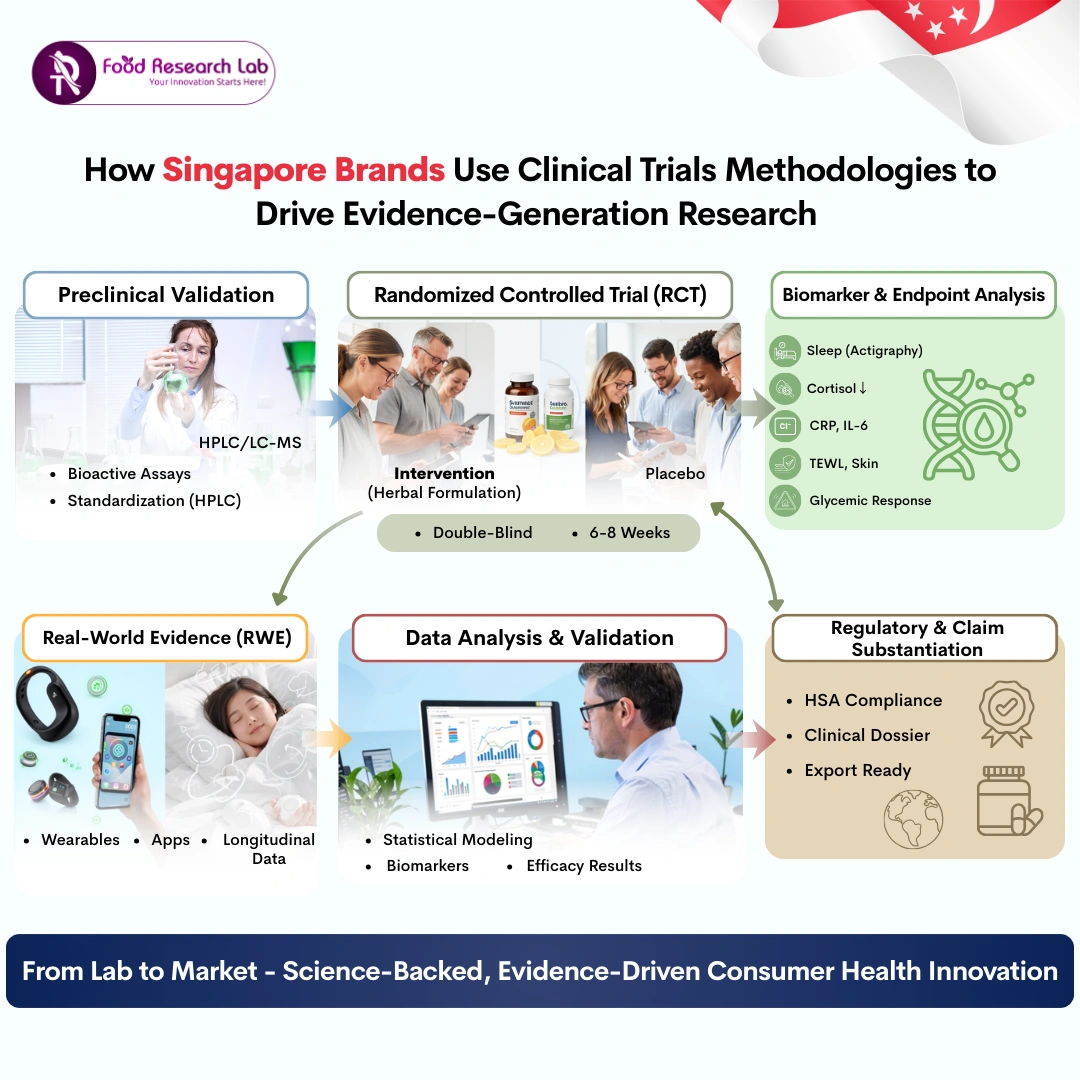
How Singapore Brands Use Clinical Trials Methodologies to Drive Evidence-Generation Research
Evidence generation is the systematic process of collecting, analyzing, and interpreting data—through clinical trials, observational studies, and real-world data (RWD)—to demonstrate the safety, efficacy, and value of healthcare products. This organized evidence generation process is the backbone of research and evidence generation in the consumer health industry. Singapore has been identified as the leading science innovation hub in the Asian consumer health industry, thanks to the robust regulatory credibility and oversight of the Health Sciences Authority (HSA). [1]
Brands in functional foods, nutraceuticals, herbal products, cosmeceuticals, and functional beverages, in line with WHO’s guidelines on evidence generation are moving from claims-driven innovation to evidence-based healthcare innovation. Clinical validation is no longer a choice; it is an essential part of the medical product lifecycle management and regulatory compliance in clinical research. [2]
Singapore brands have organized clinical research frameworks to support regulatory evidence requirements and compete in the ASEAN, EU, and US markets. This comprehensive lifecycle approach embodies the Integrated Evidence-Generation approach, making brands credible, export-ready, and innovation-driven leaders.
Singapore’ s Consumer Health Regulatory and Research Ecosystem
Regulatory Compliance of Clinical Research Framework and Ethical Evidence Generation
The regulatory framework in Singapore is clear and supports the ethical evidence generation. The Health Sciences Authority regulates health supplements, traditional medicines, and cosmetic products to ensure that their claims are honest and not misleading, with claims based on scientific data and aligned with regulatory evidence requirements.
Advertising claims are governed by guidelines from the Advertising Standards Authority of Singapore (ASAS), while human studies are governed by the Personal Data Protection Act (PDPA) to ensure the protection of data. Institutional Review Boards (IRBs) also ensure that there is ethical evidence generation. For low-risk studies, there is a simplified review process to promote innovation without undermining regulatory compliance in clinical research.
Research & Innovation Infrastructure Supporting Data-Driven Healthcare Research
The data-driven health care research and translational medical research ecosystem in Singapore is made possible by the A*STAR Agency for Science, Technology and Research in the areas of bioactive compounds, food innovation and translational science. Academic collaboration with the National University of Singapore and Nanyang Technological University supports the pharmaceutical research validation and applied consumer health research.
In addition, the multi-ethnic population in Singapore, with its mix of Chinese, Malay, Indian and other Asian populations provide diverse cohorts for studies, enabling brands to generate relevant healthcare product validation, supporting broader Asian market expansion. [3]
Clinical Methodologies Mean in Consumer Health Evidence Generation
In consumer health, clinical methodologies are a part of the overall medical evidence generation plan to substantiate claims of safety, efficacy, and functionality for products. In contrast to the traditional pharma evidence generation, the consumer health evidence generation process has a streamlined lifecycle:
- Preclinical validation to support mechanism of action
- Human intervention studies to support measurable endpoints
- Post-market observational validation to assess real-world performance
This organized evidence generation for health product R&D enables compliant and defensible claims. Typical study designs include Randomized Controlled Trials (RCTs), cross-over dietary intervention studies, observational cohort studies, and cross-sectional safety studies. Sound clinical trial design, statistical analysis, and biomarker choice help ensure that results are consistent with marketing and regulatory requirements. The emphasis is on measurable, replicable, and claim-valid outcomes. [4]
Foundational Evidence-Generation Methodologies
Preclinical & Mechanistic Validation
Preclinical studies support healthcare product validation in brands with in vitro testing for antioxidant activity (DPPH, ORAC assays) and anti-inflammatory properties (cytokine modulation). Enzyme inhibition analysis examines metabolic pathways, while gut microbiome simulators test prebiotics. Franz cell penetration assays (diffusion cells measuring absorption of active ingredients) are used in cosmeceuticals. Network pharmacology improves multi-target herbal compound validation within structured clinical research frameworks. These screen ingredients, validate mechanisms, and prioritize formulations for clinical advancement.
Analytical & Standardization Studies
HPLC fingerprinting and metabolomic analysis by LC-MS/MS improves medical evidence generation research by verifying integrity of marker compounds. Stability testing according to ICH guidelines predicts product shelf life, while dissolution and bioavailability models verify release rates. This approach ensures pharmaceutical research validation guidelines are applied to consumer health products. This ensures product uniformity, HSA standards, and exportable claim substantiation. [5]
Clinical Trial Methodologies Used by Singapore Brands
Common Study Designs
Singapore brands use the adapted clinical trial design optimized for consumer health products, striking a balance between scientific objectivity and feasible timelines and expenses.
- Randomized Controlled Trials (RCTs): Gold standard allocating participants randomly to intervention/control groups, minimizing bias for efficacy claims.
- Double-blind Placebo-Controlled Trials: Neither the participant nor the researcher knows the group assignments, thus providing objective results for cosmeceutical/herbal product efficacy.
- Cross-over Intervention Trials: Participants serve as own controls sequentially with washouts, ideal for short-term functional beverages.
- Open-label Pilot Studies: Establish safety/dosing feasibility without blinding, first step for novel herbal formulations.
- Bioavailability Studies: Measure PK profiles (absorption/metabolism/excretion) for nutraceutical/peptide delivery claims.
- Observational Real-World Studies: Capture long-term natural usage patterns for post-market sleep/gut health validation.
- Consumer Perception and Sensory Trials: Quantify subjective benefits (VAS scales) alongside biomarkers for market positioning.
These methodologies contribute to structured integrated evidence-generation models supporting health technology assessment and market positioning. [4]
Key Clinical Endpoints by Industry
Industry | Typical Clinical Endpoints |
Nutraceuticals | Inflammatory markers (CRP, IL-6), lipid profile, glycemic response |
Functional Beverages | Hydration biomarkers (urine osmolality), cortisol levels, energy metabolism markers |
Herbal | Symptom scoring scales, inflammatory panels, liver/kidney safety markers |
Cosmeceuticals | Transepidermal water loss (TEWL), skin elasticity (cutometer), wrinkle depth, melanin index |
Functional Foods | Satiety index (VAS scales), gut microbiome diversity (16S sequencing), glycemic index |
Ethical & Operational Considerations
IRBs simplify approvals for consumer research, focusing on informed consent and vulnerability. Data protection on PDPA-compliant platforms is ensured. Good Clinical Practice (GCP) promotes reproducibility, with pre-specified statistical analysis plans (e.g., ANOVA, mixed models) confirming that findings are consistent with international health technology assessment principles.
Advanced Methodologies & Innovative Trial Design
Adaptive Clinical Trial Designs
Adaptive clinical trial design by Singapore brands improves efficiency and scientific credibility. Adjustments for interim analysis adjustments allow for protocol modification, and dose optimization strategies approaches help to quickly determine optimal ingredient doses. Bayesian statistical models inform decision-making, and sample size recalibration maintains study power without over-enrolling. These models rapidly accelerate evidence development for health product R&D, reducing expense without compromising scientific rigor.
Benefit: Faster, cost-efficient validation for nutraceuticals and cosmeceuticals.
Real-World Evidence (RWE) Integration
Real-world evidence (RWE) is a complement to traditional clinical trials because it provides real-world product performance. The Singapore brands use tools and techniques for real-world evidence creation, such as digital health data capture platforms, wearable monitoring (sleep, stress, activity), mobile health tracking, and Continuous Glucose Monitoring (CGM) for metabolic analysis.
Longitudinal consumer tracking and e-commerce behavioral analysis help in the long-term analysis of outcomes and post-market validation. This is also a part of real-time evidence generation, where digital tools help in continuous data collection as a part of the process of real-time evidence generation.
Integration of digital health data analytics helps in long-term product validation, and it also helps in increasing regulatory confidence and making decisions across the product lifecycle. [6]
Highly relevant for:
Lifestyle supplements
Functional beverages
Preventive wellness products
Omics-Based Evidence Platforms
The latest omics technologies enhance precision validation. Microbiome sequencing analyzes gut modulation, metabolomics analyzes biochemical modifications, nutrigenomics analyzes gene-diet interactions, and proteomics-based biomarker mapping enhances multi-target herbal validation strengthen translational medical research and personalized product positioning. These methods enhance integrated evidence generation in multi-target herbal and nutraceutical products.
Application: Personalized nutrition and complex botanical substantiation
Decentralized & Hybrid Clinical Trials
Decentralized clinical trials improve compliance and accessibility and decrease site dependence. Remote patient monitoring and telemedicine consultations reduce the need for clinic visits, and electronic Patient-Reported Outcome (ePRO) capture systems provide real-time patient feedback to enable real-time evidence generation.
Home-based patient sample collection allows for long-term biomarker analysis without frequent site visits, making medical product life cycle management possible through continuous data loops. [7]
Ideal for: Sleep beverages, cognitive supplements, long-term gut health trials.
Digital Biomarker & Systems Biology Integration
Digital biomarkers bring together continuous glucose monitoring (CGM), activity and stress tracking, and real-time physiological data for a holistic data-driven healthcare research solution.
Multi-marker validation models and mechanism-driven computational pathway analysis identify functional impacts along complex networks of biological pathways, improving mechanistic understanding in clinical research frameworks.
This advanced integration supports evidence-based healthcare innovation through precise, reproducible outcomes.
Industry-Specific Applications in Singapore
Industry Category | Testing Methodologies | Key Equipment/Techniques | Primary Applications |
Food | Glycemic index protocols, nutritional profiling, sensory trials | Continuous monitoring, LC-MS/MS | Low-GI claims validation, contaminant screening, consumer acceptance |
Beverage | Nutri-Grade RCTs, hydration monitoring | Continuous glucose monitoring | Sugar reduction impact, energy/hydration claims |
Nutraceutical | Pharmacokinetic studies, toxicology panels | PK analysis platforms | Actives bioavailability, safety profile confirmation |
Herbal | Cross-sectional safety studies, standardization assays | Marker compound analysis, herb-drug interaction panels | TCM user safety, botanical consistency, interaction monitoring |
Cosmeceutical | Patch testing, barrier function assessment, wrinkle imaging | TEWL meters, high-resolution imaging | Irritation assessment, skin barrier quantification, multi-functional claims |
Food Research Lab Insight: Structured Evidence-Generation Model (Case Example – Herbal Sleep Formulation)
A Singapore-based brand engaged Food Research Lab to validate an herbal sleep supplement with standardized extracts of Ashwagandha (300 mg), Valerian root (200 mg), and Passionflower (150 mg). The proposed claims were “supports restful sleep” and “reduces sleep onset time.” But the brand was struggling with challenges in dosage substantiation, biomarker identification, and regulatory support for international export.
Challenges Identified
- Insufficient localized information on optimal dosage in Asian ethnic groups
- Variability in herbal extract standardization
- Difficulty selecting objective sleep endpoints beyond self-reported surveys
- Ensuring non-sedative safety profile
- Aligning clinical outcomes with compliant claim language
FRL’s Structured Integrated Framework
- Scientific literature mapping – Identified clinically studied dosage ranges and synergistic herb interactions.
- Mechanism-of-action validation – Evaluated GABA modulation and cortisol reduction pathways.
- Analytical standardization – Confirmed marker compounds (withanolides, valerenic acids) via HPLC.
- Clinical protocol development – Designed a randomized, double-blind, placebo-controlled 6-week study.
- Adaptive study design – Interim sleep diary trend assessment to confirm response patterns.
- Biomarker and endpoint selection – Sleep onset latency, total sleep time (actigraphy), salivary cortisol, Pittsburgh Sleep Quality Index (PSQI).
- Statistical modeling – Power calculation for 80% significance confidence.
- Regulatory-aligned dossier preparation – Structured documentation supporting non-therapeutic sleep support claims.
This structured evidence generation process strengthened pharmaceutical research validation principles adapted to consumer health.
Outcome
- Validated optimal nightly dosage
- Objective and subjective sleep improvement data
- Stronger claim substantiation for ASEAN export
- Enhanced market differentiation in the competitive sleep supplement category
Conclusion
Singapore brands have been able to turn the concept of evidence generation into a competitive advantage. The companies use structured research and evidence generation, flexible clinical trial design, and Real-Time Evidence Generation to promote sustainable innovation.
For nutraceutical product development, Food Research Lab offers comprehensive evidence generation services for health product R&D, from formulation development to regulatory-friendly claim substantiation. Partner with Food Research Lab to develop clinically validated, export-grade nutraceuticals with strong scientific evidence.
References
- World Health Organization. (n.d.). Evidence generation. https://www.who.int/our-work/science-division/research-for-health/optimizing-research-processes/evidence-generation
- Roughead, E. E., & Kemp-Casey, A. (2023). Evidence generation on access to medicines by patients. In Z. U. D. Babar (Ed.), Encyclopedia of evidence in pharmaceutical public health and health services research in pharmacy. Springer. https://doi.org/10.1007/978-3-030-64477-2_134
- Health Sciences Authority. (n.d.). Clinical trials overview. https://www.hsa.gov.sg/clinical-trials/overview
- Shau, W.-Y., Setia, S., Shinde, S., Santoso, H., & Furtner, D. (2023). Generating fit-for-purpose real-world evidence in Asia: How far are we from closing the gaps? Perspectives in Clinical Research, 14(3), 108–113. https://doi.org/10.4103/picr.picr_193_22
- Medina, J., Sánchez-Covisa, J., Nuevo, J., et al. (2026). Shaping the future of evidence generation: Real-world data to drive healthcare transformation and patient-centered decisions. Pharmaceutical Medicine. https://doi.org/10.1007/s40290-025-00599-2
- Graili, P., Guertin, J. R., Chan, K. K. W., & Tadrous, M. (2023). Integration of real-world evidence from different data sources in health technology assessment. Journal of Pharmacy & Pharmaceutical Sciences, 26. https://doi.org/10.3389/jpps.2023.11460
- Abdalla, H. (2025). Decentralized clinical trials (DCTs) and the expansion of mRNA technology beyond COVID-19: Innovations, challenges, and future directions. International Journal of Advances in Engineering and Management, 7(10), 195–217. https://ijaem.net/issue_dcp/Decentralized%20Clinical%20Trials%20DCTs%20and%20the%20Expansion%20of%20mRNA%20Technology%20beyond%20COVID%2019%20Innovations,%20Challenges,%20and%20Future%20Directions.pdf

Let’s create something Innovative and Delicious together
Food Research Lab strives for excellence in new Food, Beverage and Nutraceutical Product Research and Development by offering cutting edge scientific analysis and expertise.