Manufacturing of herbal supplements is an activity that entails formulation, production, and packaging of products using contract manufacturers where increased global interest results in increasing scrutiny of herbal supplement manufacturing. In the process of pilot to commercial scale manufacturing, good results observed during laboratory formulation may not yield positive results due to problems such as potency fluctuations, variations in moisture content, unstable processes, and segregation of ingredients among others which results in rejected batches. The problem can be solved by scientific means which integrate quality control in herbal manufacturing, process design, and analytical validation.[1]

Replicating Scale-Up Performance in Herbal Supplement Manufacturing

What Science Can Do, April 25, 2026.

Manufacturing of herbal supplements is an activity that entails formulation, production, and packaging of products using contract manufacturers where increased global interest results in increasing scrutiny of herbal supplement manufacturing. In the process of pilot to commercial scale manufacturing, good results observed during laboratory formulation may not yield positive results due to problems such as potency fluctuations, variations in moisture content, unstable processes, and segregation of ingredients among others which results in rejected batches. The problem can be solved by scientific means which integrate quality control in herbal manufacturing, process design, and analytical validation.[1]

Understanding Scale-Up Performance in Herbal Manufacturing.

The definition of scale-up efficacy can be defined as having the ability to replicate the results of the batches produced under laboratory or pilot scale conditions in industrial manufacturing operations. There needs to be synchronization of the formulation, manufacturing process, and raw materials when making custom herbal supplement manufacturing.[1]

Even if the formula works well in a laboratory environment, it will have totally different attributes when manufactured industrially because of differences in shear effects, mixing processes, and environmental conditions. Hence, the challenge in making herbal supplements involves not only formulation but also quality assurance in herbal supplement. Performance indicators that define successful scale-up include:

  • Concentration of marker by standardization of herbal extracts
  • Homogeneous blend of each batch
  • Dissolution and disintegration kinetics that are consistent
  • Avoidance of moisture for preventing deterioration
  • Proper flow behavior for efficient manufacturing
  • Homogenous fill mass for encapsulation
  • Product stability for sustained shelf life

Meeting these parameters is essential for complying with herbal supplement quality standards and global herbal product regulatory requirements .[2]

Scientific Challenges Unique to Herbal Supplements

Raw Material Variability

While chemicals are consistent in nature, natural products show variations that have an impact on their properties. Season, origin of collection, and processing practices affect the chemical constitution of medicinal plants, which makes it necessary to design standardization of herbal extracts and herbal extract testing methods.[3]

Processing Considerations

The following are the problems associated with the handling of herbs:

  • Delicate components that are heat-sensitive during drying and tableting processes
  • High sorption capacity leading to hygroscopic properties and making handling difficult
  • High stickiness due to high oil content

Such factors complicate quality assurance in herbal supplements.

Dosage Form Problems

The following are some problems associated with various dosage forms:

  • Capsules – poor flow characteristics leading to fill weight variations
  • Tablets – problems with capping, lamination, and tablet hardness
  • Powders – problems with segregation and settling

Addressing these issues is crucial for maintaining botanical supplement safety standards and ensuring compliance with herbal product regulatory requirements.[3]

What Science Can Do: Technologies That Improve Scale-Up Replication

Process Engineering

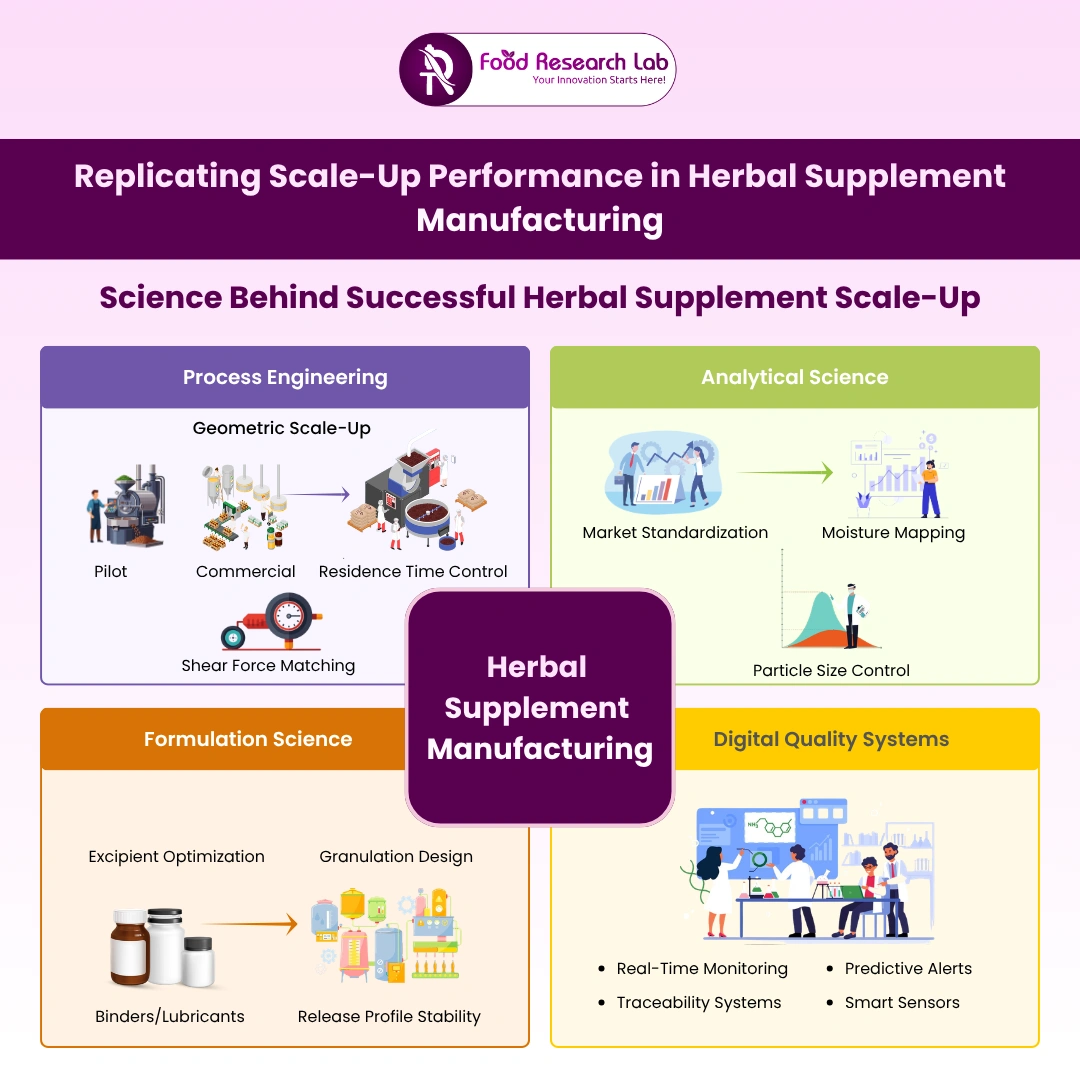
The scientific process scale-up depends greatly on engineering fundamentals. Such tools as geometric scale-up calculations and studies of equivalent shear force facilitate efficient mixing regardless of equipment scale. The use of residence time mapping and parameter translation helps to ensure that the same processing conditions are used as pilot to commercial scale manufacturing.

The described strategies are crucial to achieving compliance with the rules of herbal manufacturing and minimizing failures during production.[4]

Analytical Science

The advanced technological solutions enable quality control in herbal manufacturing.

  • The use of HPLC guarantees marker compound consistency
  • Moisture profile mapping is aimed at prevention of degradation and contamination
  • The assessment of particle size helps to achieve efficient blending
  • Bulk density distribution improves flow and compression characteristics

The combination of herbal extract testing methods is a prerequisite for successful manufacturing.

Formulation Science

Reformulation of excipients instead of simple batch scale-up is often required to ensure high-quality products.

  • The optimization of binders and lubricants results in better tablet formation
  • Effective granulation techniques increase the flow properties
  • The adjustment of excipient proportions provides consistent release profiles

These tools strengthen quality assurance in herbal supplements and align operations with nutraceutical GMP guidelines.

Application Areas in Herbal Supplement Manufacturing

Product Type

Key Requirement

Scale-Up Challenge

Scientific Focus Area

Ashwagandha Capsules

Consistent extract potency

Poor flowability, fill weight variation

Standardization of herbal extracts & flow optimization

Turmeric Curcumin Tablets

Controlled dissolution

Capping, hardness variation

Compression control & dissolution optimization

Herbal Immunity Powders

Uniform blending

Ingredient segregation, settling

Blend uniformity & particle size control

Effervescent Botanical Blends

Moisture sensitivity

Premature reaction, stability loss

Moisture control & packaging optimization

Gummies with Plant Extracts

Stability & uniformity

Heat sensitivity, uneven distribution

Thermal stability & mixing consistency

Liquid Herbal Tonics

Microbial safety & stability

Contamination, phase separation

Preservation systems & stability testing

Functional Tea Premixes

Easy dispersion

Poor solubility, settling

Particle engineering & dispersion optimization

Reverse Engineering Case Study: Replicating a Failed Commercial Scale-Up

Client Problem

A nutraceutical company faced challenges after scaling up turmeric and boswellia tablets despite successful pilot trials.

Commercial Failure Observed

  • Inconsistent tablet hardness
  • Slower dissolution compared to pilot batches
  • High rejection rates due to capping
  • Noticeable batch-to-batch color variation

Reverse Engineering Investigation

Step 1: Input Evaluation

Whereas there was consistency in the formulation, there were differences in particle sizes and high moisture content in the materials.

Step 2: Process Flow Chart

The equipment used for manufacture did not represent the pilot process. There were great inconsistencies in the speed of blending and compression.

Step 3: Analysis & Diagnosis

There was excessive use of lubricants that reduced particle cohesion, while the agglomeration of extracts reduced consistency, indicating quality control in herbal manufacturing.[5]

Scientific Solution

  • Particle size specifications were defined by standardization of herbal extracts
  • Pre-drying was employed to control moisture content
  • Lubricant was minimized
  • The rates of compression and machine were adjusted

Outcomes

  • Reduction in tablet rejections by 82%
  • Dissolution was like pilot specifications
  • Conformity in hardness
  • Success in large-scale production

Science-based solutions are useful in solving scale-up herbal manufacturing compliance and botanical supplement safety standards.[5]

Conclusion

Achieving scale-up replication in herbal supplements manufacturing is an art which involves the integration of formulation science, process engineering, and validation processes. When you have quality control herbal supplement manufacturing, nutraceutical GMP guidelines and standardization of herbal ingredients, the result will be a commercial product that is consistent, compliant, and quality.

Work with Food Research Lab, an expert in herbal formulation services, to ensure successful scale-up replication of your herbal supplement product.

References

  1. Shahrajabian, M. H., Sun, W., & Cheng, Q. (2023).
    Herbal medicines: Current status, challenges, and future perspectives in pharmaceutical applications. Phytotherapy Research, 37(2), 728–742.
    https://doi.org/10.1002/ptr.7645
  2. Kunle, O. F., Egharevba, H. O., & Ahmadu, P. O. (2022).
    Standardization of herbal medicines—A review. International Journal of Biodiversity and Conservation, 14(1), 1–12.
    https://doi.org/10.5897/IJBC2021.1500
  3. Patel, S., & Krishnamurthy, R. (2024).
    Quality control and regulatory requirements for herbal drug products: A global perspective. Journal of Herbal Medicine, 41, 100682.
    https://doi.org/10.1016/j.hermed.2023.100682
  4. Rathore, S., & Sharma, P. (2023).
    Process optimization and scale-up strategies in nutraceutical manufacturing. Journal of Food Process Engineering, 46(5), e14256.
    https://doi.org/10.1111/jfpe.14256
  5. Ekor, M. (2022).
    The growing use of herbal medicines: Issues relating to safety, quality, and efficacy. Frontiers in Pharmacology, 13, 1012345.
    https://doi.org/10.3389/fphar.2022.1012345