Regulatory packaging compliance guarantees the materials are suitable for their intended use, safe for the environment, and provides the mandatory information to the consumer. In the UK, pet food product development is defined legally as animal feed and the packaging of this product comes under a strong regulatory framework. The UK packaging sector is dictated by Retained Regulation (EC) No 767/2009, the Feed (Hygiene and Enforcement) Regulations and more than 50 statute instruments. In line with enforced Extended Producer Responsibility (EPR) and the 223.69 per tonne Plastic Packaging Tax (PPT) and impending Product Regulation and Metrology Act 2025, advanced compliance packaging and intelligent packaging systems must be implemented for companies to reach compliance. In this article we will cover UK pet food manufacturers implementation of UK packaging laws via digital packaging technology rather than a general overview of the technology. [1] [2]
How UK Pet Food Industry Applies Regulatory Packaging Compliance for Advanced Packaging Intelligence
Regulatory packaging compliance guarantees the materials are suitable for their intended use, safe for the environment, and provides the mandatory information to the consumer. In the UK, pet food product development is defined legally as animal feed and the packaging of this product comes under a strong regulatory framework. The UK packaging sector is dictated by Retained Regulation (EC) No 767/2009, the Feed (Hygiene and Enforcement) Regulations and more than 50 statute instruments. In line with enforced Extended Producer Responsibility (EPR) and the 223.69 per tonne Plastic Packaging Tax (PPT) and impending Product Regulation and Metrology Act 2025, advanced compliance packaging and intelligent packaging systems must be implemented for companies to reach compliance. In this article we will cover UK pet food manufacturers implementation of UK packaging laws via digital packaging technology rather than a general overview of the technology. [1] [2]
UK Pet Food Regulatory Packaging Compliance Landscape
The regulation of the packaging of animal food in the UK falls into 4 regulatory bodies:
- FSA for the application of Animal Feed Regulations
- DEFRA for the regulation of packaging laws and environmental reports
- The Environment agency for the regulation of waste, APHA for hygiene regulations and UK REACH for hazardous materials regulation
Every manufacturer is registered as Feed Business Operator (FBO), thus requires recording accurate records. Current legislative changes such as EPR, PPT, and the impending Metrology Act regulations will put great demands on the accurate regulatory packaging management, whereby the EPR would require the reporting of household/non-household data and costs determined by the weight of the packaging, PPT demands proof of material (by HMRC) of any plastic packaging which falls under the threshold of 30% of recycled content and Metrology Act with very stringent demands on the accuracy of net quantities making intelligent labelling systems important. As the manufacturer would look for a UK packaging compliance solution for the packaging regulatory standards. [3] [4]
UK Pet Food Manufacturers – Key Packaging Compliance Issues
Packaging Material Compliance
Packaging materials must be food-grade with same level of protection to human food. Manufacturers need to make sure that they comply with UK REACH limitations and be able to produce relevant migration tests.
Specific Technical Requirements for Pet food packaging.
- For Wet Pet food (retort pouches, Aluminium trays), packaging material needs to resist 121°C thermal sterilization and to ensure seal integrity.
- For Dry Pet food (multi-layer pouch), moisture barrier performance must provide a low WVTR value (< 1 g/m/day) and resist to oxidation.
- Raw Pet food packaging must allow a cold-chain integrityand pathogen containment.
The Plastic Packaging tax will give an incentive to producers to use mono-material pouches or paper-based systems and will support usage of recycled content and compliance with eco-friendly packaging compliance. Migration tests on new materials are compulsory. The use of sustainable packaging standards and their compliant sourcing and utilization have become extremely important not to face regulatory and reputation related issues. [5]
What are the FDA labelling requirements for pet food?
As laid down by Retained Regulation (EC) No 767/2009, labelling must bear minimum indications: Species designation, e.g. ‘for dogs’; Analytical constituents (protein, fat, fibre and ash); Additives; Batch reference and FBO number; Net quantity and best before date.
Ingredients should be indicated by descending order in weight. When any ingredient is highlighted, the quantity of this ingredient should be stated as percentage; Medicinal claims cannot be applied. According to Product Regulation and Metrology Act 2025, the tolerances for net quantities would be tighter, and automated packaging monitoring of packing will need to be utilized with a support of smart packaging compliance tools.
Traceability and documentation
FBOs need to maintain traceability of batches, from supply up to the final production, to manage product recalls efficiently. EPR reporting depends on correctly documented and verified plastic weight/composition. Documents must be easily auditable, by DEFRA authorities. Nowadays, digital packaging technology helps Packaging quality assurance procedures to be applied on labels in ranges of products. [6]
How Advanced Packaging Intelligence Supports Compliance
Advanced Packaging Intelligence closes the gap between regulation and execution through automating the verification of compliance.
AI-Powered Label Verification
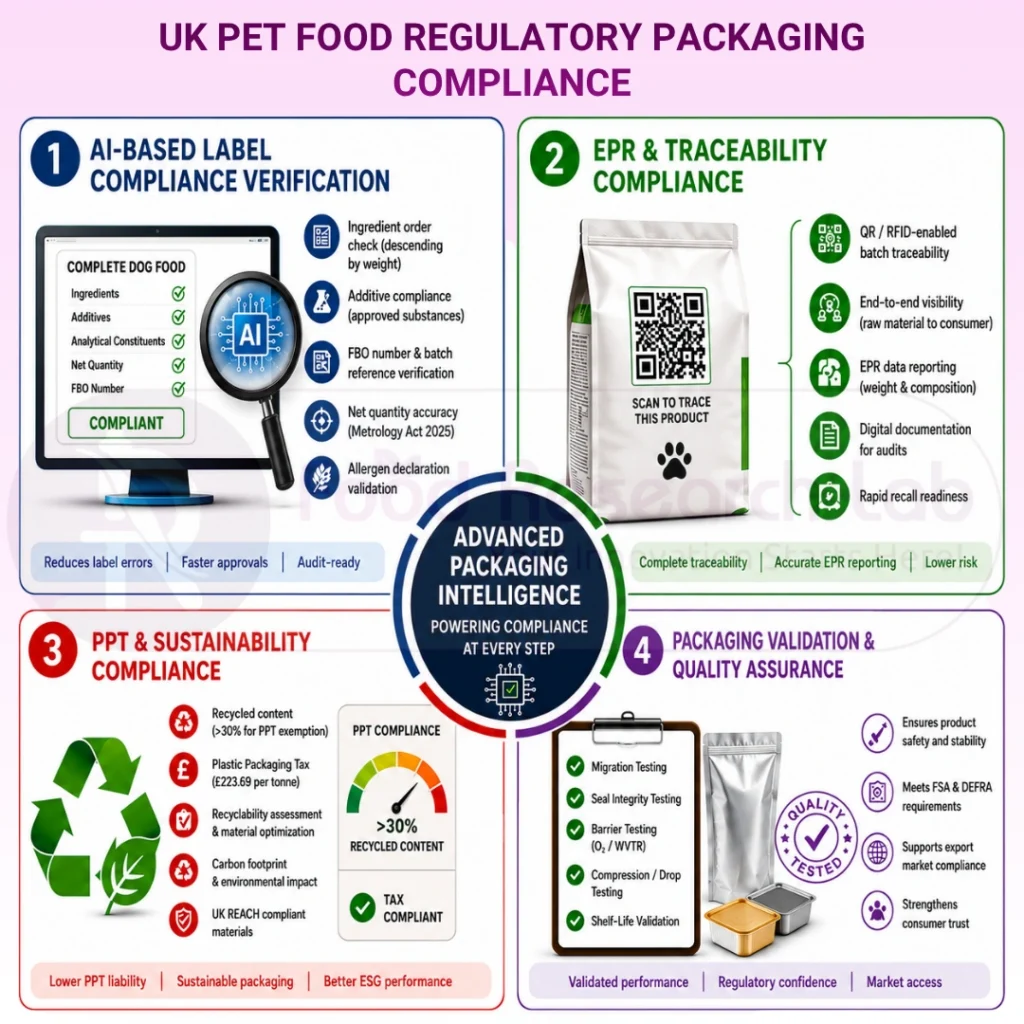
AI is used to automate label scanning and verification against FSA feed rules using Natural Language Processing (NLP). This will be used to automatically verify:
- Ingredient sequence (descending order of weight)
- Additive compliance (only approved ingredients used)
- Allergen declaration
- Net quantity accuracy in relation to the Metrology Act tolerance
This provides a shortened label approval process and prevents regulatory infringement. Tools for packaging risk management identify the potential for contaminants, migration and documentation failures. This is particularly useful during pet food formulation and processing trials. [7]
Smart Traceability Systems
Using a variety of QR code and RFID technology this system can track batches from raw ingredients to the consumer and blockchain data is immutably recorded so will be perfect for markets requiring countries of origin for exports. In the event of a product recall it can identify affected batches in minutes. Intelligent packaging systems provides end-to-end visibility, streamlined root cause analysis and support for evolving packaging regulatory standards.
Packaging Sustainability Analytics
Analytics provide insights for EPR fee exposure by modelling liability based on material weight, composition and recyclability. Carbon footprints are calculated and packaging waste calculated. They verify percentages of recycled content for PPT compliance, enabling the optimization of mono materials to avoid taxes, while improving overall sustainability. Embedding analytics with smart packaging compliance systems allow for constant monitoring, regulatory reporting and continuous optimization of packaging. [8]
Technical Packaging Validation for Pet Food Products
To be compliant, packaging validation testing should be conducted prior to commercial launch. Effective Packaging quality assurance ensures an “audit-ready” state.
Table 1: Technical Packaging Validation Requirements for UK
Test Type | Purpose | Pet Food Application |
Migration Testing | Verify no toxic transfer | Wet/dry food safety (UK REACH) |
Seal Integrity | Ensure hermetic seal | Retort pouches (wet food) |
Barrier Testing | Measure O₂/WVTR | Dry food oxidation control |
Compression/Drop | Validate durability | Shipping safety |
Shelf-Life Validation | Confirm stability | Fat rancidity, microbial growth |
These are particularly relevant to premium pet food formulations , where packaging performance is vital to product stability and more manufacturers are outsourcing testing to validate regulatory packaging management.
Step-by-Step Compliance Implementation Plan
Step 1 – Gap Identification: Audit packaging design and labels against FSA feed laws and DEFRA packaging rules to find non-compliances in UK packaging regulations.
Step 2 – Material Assessment: Check UK REACH restrictions, compute plastic tonnage for PPT thresholds, and measure recyclability against sustainable packaging standards.
Step 3 – Smart Label Inspection: Use intelligent labelling systems to check ingredient order, additive compliance, FBO number visibility, and Metrology Act net quantity accuracy via automated packaging monitoring.
Step 4 – Traceability Validation: Test QR/RFID for end-to-end visibility using intelligent packaging systems for granular batch identification.
Step 5 – EPR & FBO Documentation: Complete EPR registrations, maintain packaging waste records, and manage FBO documentation for DEFRA audits using digital packaging technology.
Step 6 – Ongoing Assurance: Deploy AI surveillance for regulatory updates and packaging risk management systems for packaging quality assurance.
Step 7 – Export Readiness: Verify labelling for EU, GCC, and other target export markets, ensuring eco-friendly packaging compliance and regulatory packaging management. [1]
Case Study: UK Pet Food Manufacturer Enhances Compliance
Client Brief
Food Research Lab was approached by a UK pet food manufacturer that was preparing for expansion into the EU and GCC markets. The manufacturer was struggling with Plastic Packaging Tax obligations, packaging traceability, sustainability reporting and FBO data.
Solution
The food manufacturer was helped by implementing intelligent labelling systems, digital packaging technology, QR traceability and packaging data analytics for more robust reporting.
Results
- An 18% decrease in Plastic Packaging Tax exposure by using recycled content.
- A 30% increase in the rate of label approval process through automated compliance checking.
- Complete batch traceability achieved by using QR tracing technologies.
- The ability to report accurately to the EPR bodies and for auditability.
The exercise increased regulatory packaging management, decreased compliance risks and aided market expansion into new markets.
Conclusion
As new needs rise, so too will the use of intelligent packaging systems, digital packaging technology, and regulatory packaging compliance strategies in the pet food industry due to the needs of EPR, the Plastic Packaging Tax, and the Product Regulation and Metrology Act 2025. Manufacturers can alleviate risks, ensure transparency, and enhance market access with the appropriate level of traceable and eco-friendly, regulation-compliant packaging practices.
Food Research Lab can assist pet food manufacturers with end-to-end pet food product development services by offering complete compliance, regulatory advisory services, and formulating and product expertise to help get a safe, compliant, marketable product to consumers.
References
- Thapliyal, D., Karale, M., Diwan, V., Kumra, S., Arya, R. K., & Verros, G. D. (2024). Current Status of Sustainable Food Packaging Regulations: Global Perspective. Sustainability, 16(13), 5554. https://doi.org/10.3390/su16135554
- Singh, P. K., N.Agrawal, and A. K.Khare. 2026. “Artificial Intelligence: An Advanced Tool to Improve Safety and Quality in the Meat Industry.” Journal of Food Process Engineering49, no. 2: e70383. https://doi.org/10.1111/jfpe.70383.
- Brittany L. White, Billie L. Johnson, Russell Morgan, Richard G. Shields, Chapter 1 – Changes in the Food Safety Landscape of Pet Foods in the United States, Editor(s): Steven C. Ricke, Griffiths G. Atungulu, Chase E. Rainwater, Si Hong Park, Food and Feed Safety Systems and Analysis, Academic Press, 2018, Pages 3-23, ISBN 9780128118351, https://doi.org/10.1016/B978-0-12-811835-1.00001-4. (https://www.sciencedirect.com/science/article/pii/B9780128118351000014)
- Tacker, M., & Neumair, C. (2026). Regulatory and legal considerations in food packaging. In Safety and Sustainability Aspects of Food Packaging(pp. 363-378). Academic Press.
- Kalpio, K. (2024). Implementing transparency in the dry dog food industry.
- Hobbs, L., Jr., Shanoyanb, A., & Aldrich, G. (2024). Assessing research needs for informing pet food industry decisions. International Food and Agribusiness Management Review, 27(5), 903-936. https://doi.org/10.22434/ifamr2023.0004
- Sharma,Rishav Kumar, 20240290578, English, Journal article, Kazakhstan, doi:10.48184/2304-568X-2024-2-103-111, 2710-0839 2304-568X, 144, (2), Almaty, The Journal Of Almaty Technological University, (103–111), Almaty Technological University, Advancements in artificial intelligence- imaging analysis (IA) systems technology for comprehensive quality evaluation of pet food products., (2024)
- Davidescu, M. A., Pânzaru, C., Mădescu, B. M., Poroșnicu, I., Simeanu, C., Usturoi, A., Matei, M., & Doliș, M. G. (2025). Advances and Challenges in Smart Packaging Technologies for the Food Industry: Trends, Applications, and Sustainability Considerations. Foods (Basel, Switzerland), 14(24), 4347. https://doi.org/10.3390/foods14244347

Let’s create something Innovative and Delicious together
Food Research Lab strives for excellence in new Food, Beverage and Nutraceutical Product Research and Development by offering cutting edge scientific analysis and expertise.