Toxicology and chemical safety in Indonesia are governed by strict regulations, particularly regarding the registration of hazardous substances (B3) manufactured or imported into the country, regulated by the Ministry of Environment and Forestry. On the other hand, Indonesia's booming food, beverage, herbals, nutraceuticals, and cosmeceuticals industry is progressively becoming more aware of the need for scientific validation for safety, where toxicology chemical safety Indonesia becomes necessary to meet regulatory compliance. With Indonesia’s wide diversity of plant species and its popularity of traditional medicine, including the jamu plant formulation, it is important to take into consideration all possibilities as it pertains to toxicology since natural products can have bioactive, contaminants, or variability that require rigorous hazardous substance assessment. With consumers’ growing concerns about toxic chemicals and their long-term impact on their health, brands are adopting a science-backed approaches, with toxicology methodologies playing a critical role in enabling reliable chemical safety diagnostics, reducing risks, and strengthening market credibility. [1]
How Indonesia’s Brands Use Toxicology Methodologies to Drive Chemical Safety Diagnostics
Toxicology and chemical safety in Indonesia are governed by strict regulations, particularly regarding the registration of hazardous substances (B3) manufactured or imported into the country, regulated by the Ministry of Environment and Forestry. On the other hand, Indonesia’s booming food, beverage, herbals, nutraceuticals, and cosmeceuticals industry is progressively becoming more aware of the need for scientific validation for safety, where toxicology chemical safety Indonesia becomes necessary to meet regulatory compliance. With Indonesia’s wide diversity of plant species and its popularity of traditional medicine, including the jamu plant formulation, it is important to take into consideration all possibilities as it pertains to toxicology since natural products can have bioactive, contaminants, or variability that require rigorous hazardous substance assessment. With consumers’ growing concerns about toxic chemicals and their long-term impact on their health, brands are adopting a science-backed approaches, with toxicology methodologies playing a critical role in enabling reliable chemical safety diagnostics, reducing risks, and strengthening market credibility. [1]
What are Toxicology Methodologies to Drive Chemical Safety Diagnostics?
Toxicology methodologies can be described as scientific techniques used to determine the negative impacts of chemicals on biological systems. Such methodologies help identify, measure, and predict the potential risks of such chemicals’ exposures, which become the foundation for advanced chemical risk profiling.
Chemical safety diagnostics entails detection, analysis, and interpretation of hazardous substances within a product, followed by an assessment of their impact on human health.
The combination of both toxicology methodologies and chemical safety diagnostics forms a complete data-driven approach that helps brands to:
- Identify any harmful chemicals within their raw materials and products
- Determine their toxicity levels depending on various exposure conditions using advanced toxicology testing methods.
- Set safe consumption levels and compliance measures
- Predict long-term health impacts
This integrated approach allows Indonesian brands to transition from reactive safety checks (testing after issues arise) to proactive and predictive risk assessment, ensuring safety from the earliest stages of product development and strengthening overall product safety Indonesia standards. [2]
Core Principles of Toxicology in Chemical Safety Diagnostics
In the field of toxicology, there are several principles that are very important in terms of determining the chemical safety diagnostics and risk evaluation:
Dose–Response Relationship in Chemical Risk Profiling
One of the main toxicological principles is “the dose makes the poison”. It means that any chemical may have a positive or negative effect based on the amount consumed or exposed. Even useful substances such as vitamins and natural compounds may be toxic when taken at high concentrations.
Dose evaluation is critical, especially in Indonesian herbal and nutraceutical formulations where bioactive concentrations vary significantly, making accurate chemical risk profiling essential.
Exposure Pathways
Understanding how a chemical enters the body is essential for evaluating its impact:
- Oral exposure: Through food, beverages, and nutraceuticals
- Dermal exposure: Through skin contact in cosmeceuticals and topical products
Each pathway affects how a substance is absorbed, distributed, and metabolized in the body, influencing its overall toxicity.
Types of Toxicity
There are various forms of toxicities that are used to evaluate the safety of chemicals both in the short and long terms:
- Acute toxicity: It causes immediate adverse effects to health due to contact with the material
- Chronic toxicity: Effects that develop over prolonged or repeated exposure
- Allergenicity and irritation: Reactions such as skin irritation or sensitivity, especially relevant for product development in cosmetics.
- Bioaccumulation: Gradual build-up of substances in the body over time, potentially leading to harmful effects
Evaluating these categories ensures a comprehensive understanding of safety and supports robust hazardous substance assessment.
Hazard vs Risk
- Hazard: The inherent ability of a substance to cause harm
- Risk: The likelihood of harm occurring under specific exposure conditions
A substance may be hazardous, but the actual risk depends on how much and how often exposure occurs. This distinction is essential for accurate safety assessment and regulatory decision-making. [3]
Key Toxicology Methodologies Used for Product Safety Indonesia
In Vitro Testing Approaches
In vitro techniques involve the use of cell-based systems in assessing toxicity in absence of organismal involvement. These involve simulation of the response that human cells respond for exposure to chemicals and are widely used in modern toxicology testing methods. Common methods include:
- Cytotoxicity assays: Measure cell damage or vitality upon exposure to a particular substance
- Skin and eye irritation models: Test potential irritation of chemicals for cosmeceutical products
These methods are increasingly preferred because they offer:
- Fast test results, allowing quicker decision-making
- Ethical advantages, by reducing reliance on animal testing
- Cost efficiency, making them suitable for routine safety screening
In Vivo Studies (Where Required)
If a deeper assessment is required, especially regarding systemic or chronic effects, biological tests are performed under controlled conditions. These are useful for determining:
- Chronic toxicity upon repeated exposure
- Metabolic activities of substances within the body
- Organ-specific effects, such as impact on liver or kidneys
In Indonesia, these are conducted under strict regulatory oversight to ensure responsible use and compliance with product safety Indonesia frameworks.
Analytical Chemistry-Based Diagnostics
Various analytical chemistry techniques are necessary for detecting and quantifying chemical hazards present within products. The chemical safety diagnostics methods are used to identify:
- Heavy metals (like lead, mercury, arsenic)
- Pesticides Residues in food items and raw materials
- Mycotoxins in grains and herbal ingredients
Chromatography and spectroscopy enable precise quantification, supporting accurate hazardous substance assessment and compliance verification.
Microbiological & Toxin Analysis
Apart from chemical hazards, products also need to be tested for potential biological hazards, which may include:
- Presence of microbial hazards (fungi or bacteria)
- Presence of toxin-producing microorganisms that can affect product safety
This is particularly critical in functional foods and custom herbal formulation development, where improper processing or storage conditions can lead to contamination and potential health risks. [4]
Advanced Toxicology Methodologies for Chemical Risk Profiling
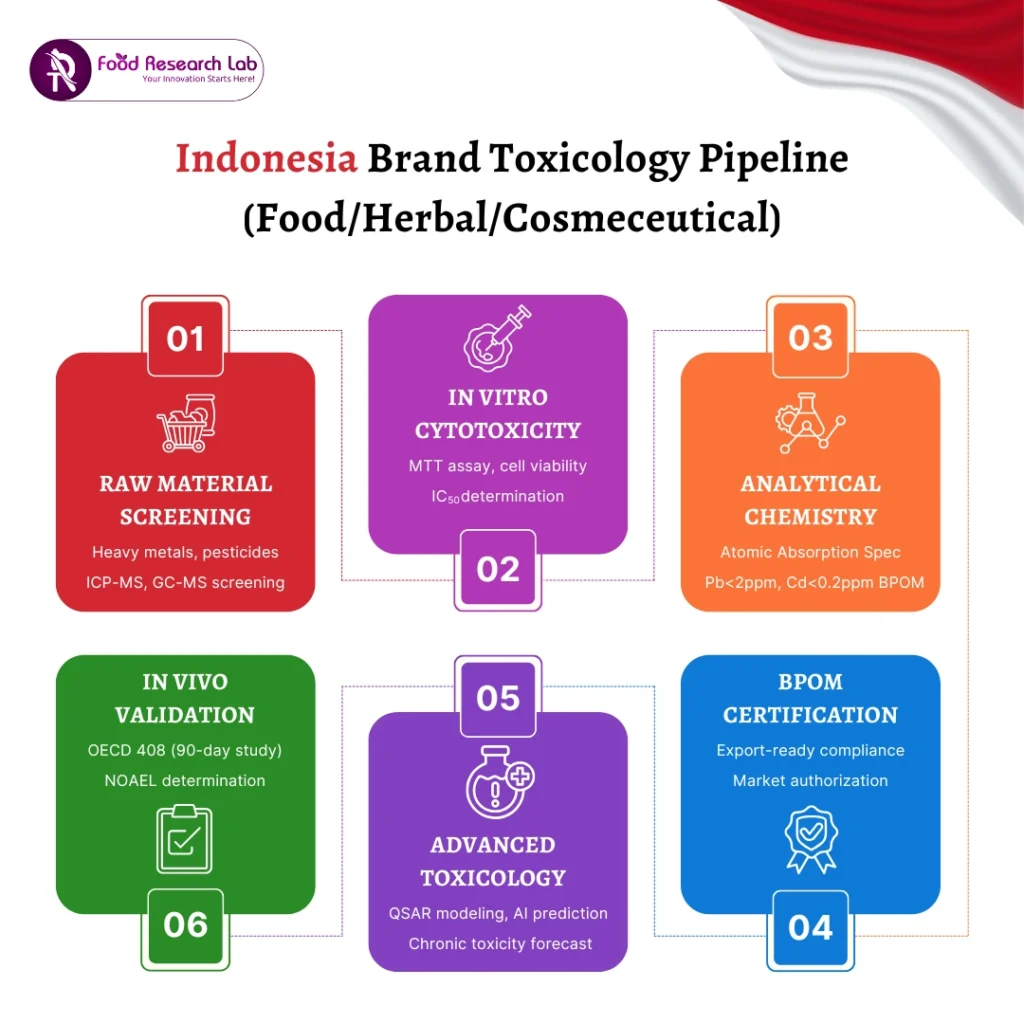
Indonesia is increasingly aligning with global advancements in toxicology through the adoption of modern, technology-driven approaches:
Computational Toxicology (In Silico Models)
Such models utilize data from chemical structures and databases for predicting toxicities without performing physical tests. They assist in preliminary screening processes and decrease dependency on experimental toxicology testing methods.
AI-Driven Toxicity Prediction
Scientists have applied artificial intelligence in analyzing vast sets of data and identifying patterns in chemical properties that can enable fast and accurate chemical risk profiling.
Omics-Based Approaches
Technologies such as genomics and proteomics allow researchers to study how biological systems respond to toxic substances at a molecular level, providing deeper insights into mechanisms of toxicity.
High-Throughput Screening
This method enables the rapid testing of multiple compounds simultaneously, significantly accelerating the safety evaluation process [5]
All the above-listed innovations can help Indonesian industries become more efficient and predictive and scalable product safety Indonesia systems.
Application of Toxicology Methodologies Across Product Safety Indonesia Industries
Industry | Safety Focus | Methodologies Applied | Outcome |
Food & Beverage | Additives, residues, processing contaminants | Chromatography, mycotoxin analysis, in vitro toxicity screening | Safe limits validation and contaminant detection |
Herbal (Jamu) | Bioactive variability, natural toxins, adulteration | Phytochemical profiling, heavy metal analysis, in vitro assays | Standardized and toxin-free formulations |
Nutraceuticals | High dose bioactives, ingredient interactions | Dose–response studies, cytotoxicity assays, interaction models | Safe dosage and interaction validation |
Cosmeceuticals | Dermal toxicity, irritation, allergenicity | Skin irritation assays, allergen screening, dermal studies | Verified skin safety and compatibility |
Key Study Highlight: Heavy Metal Contamination in Indonesian Jamu Products (JURRIKE Study)
A study published in JURRIKE evaluates lead (Pb) and Cadmium (Cd) contamination among registered and non-registered herbal (Jamu) products in Indonesia using Atomic Absorption Spectrophotometry (AAS). This paper focuses on the importance of toxicological methods in detecting the potential hazard in chemical composition in these traditional remedies.
The article highlighted that:
- Heavy metal contamination (Pb and Cd) can originate from polluted raw materials and inadequate processing, storage, and packaging conditions.
- Analysis of six dosage forms (powder, chopped, pills, capsules, cream, and shake parem) was conducted using AAS after acid digestion, with validated parameters (linearity, precision, LOD, LOQ).
- All registered herbal products met safety limits for both Pb and Cd, indicating effective quality control.
- Several unregistered products exceeded Cd safety limits, particularly in powder, chopped, and cream forms, while Pb levels remained within acceptable limits across all samples.
- The findings demonstrate that unregistered herbal medicines pose a higher risk of heavy metal contamination, emphasizing variability in quality standards.
- The study underscores the need for strict quality control, safe raw material sourcing, and regulatory compliance to ensure consumer safety.
This study highlights how toxicology methodologies combined with analytical chemical safety diagnostics are essential for detecting contamination risks and strengthening chemical safety diagnostics in Indonesia’s herbal product industry. [6]
Conclusion
Toxicological testing processes are critical in ensuring that chemical safety diagnostics can be performed effectively in Indonesia’s manufacturing sector. With the application of both advanced toxicology testing methods and predictive systems, brands can ensure safe, stable, and compliant products while strengthening product safety Indonesia standards.
Partner with Food Research Lab for end-to-end herbal formulation services, including safety validation, formulation, and toxicology-driven testing.
References
- Kashuri, M. (2024). Trend analysis of chemical drug additives (BKO) in Indonesian herbal medicines: A case study 2019–2024. CRJ, 1(4). https://doi.org/10.61402/crj.v1i4.206
- Kumar, A. (2024). Understanding chemical toxicology mechanisms, assessments, and implications. Toxicology Open Access, 10, 253. https://doi.org/10.4172/2476-2067.1000253
- Rai, N., Thakur, A., Shreepati, V., & Chavan, S. (2024). Methods and tools for toxicity assessment of herbal remedies. Journal of Pharma Insights and Research. https://doi.org/10.69613/2w9xeg16
- Kashuri, M., Ikrar, T., Sutriyo, Mun’im, A., & Yanuar, A. (2026). Evidence-based production framework for herbal medicine regulation in Indonesia. Frontiers in Pharmacology, 16, 1730273. https://doi.org/10.3389/fphar.2025.1730273
- Rokade, A. (2025). AI and omics-based approaches in predictive toxicology: Shaping the future of drug safety assessment. International Journal of Pharmacy and Pharmaceutical Research, 31, 106–111. https://doi.org/10.25166/IJPPR.2025.31.8.12
- Radanta, A. H., Indriyanti, D., Dewi, G. M. I. Y., Putri, I. C., Pramesthy, P. D. A., Modouw, T. R. G., … Prabowo, A. R. A. (2026). Analisis timbal (Pb) dan cadmium (Cd) pada jamu tradisional produk teregistrasi BPOM dan non teregistrasi BPOM dengan spektrofotometri serapan atom (SSA). Jurnal Riset Rumpun Ilmu Kedokteran, 5(1

Let’s create something Innovative and Delicious together
Food Research Lab strives for excellence in new Food, Beverage and Nutraceutical Product Research and Development by offering cutting edge scientific analysis and expertise.