Regulatory dossier interpretation Africa is evolving toward harmonized systems such as CTD/eCTD while continuing to manage country-specific requirements through National Medicines Regulatory Authorities (NMRAs), food safety agencies, and regional regulatory bodies. In all sectors including food product development, beverages, nutraceuticals, herbal, cosmeceuticals, and pet food, African organizations have adopted scientific writing techniques, online submission processes, and advanced regulatory intelligence systems to boost their exports and enhance African regulatory compliance.
How Africa's Companies Use Regulatory dossier interpretation to Meet Global Regulatory Standards
Regulatory dossier interpretation Africa is evolving toward harmonized systems such as CTD/eCTD while continuing to manage country-specific requirements through National Medicines Regulatory Authorities (NMRAs), food safety agencies, and regional regulatory bodies. In all sectors including food product development, beverages, nutraceuticals, herbal, cosmeceuticals, and pet food, African organizations have adopted scientific writing techniques, online submission processes, and advanced regulatory intelligence systems to boost their exports and enhance African regulatory compliance.
Africa’s regulatory landscape is shifting from fragmented local systems toward globally aligned frameworks supported by scientific validation, standardized technical documentation, and risk-based review models. As companies expand into international markets, accurate dossier interpretation has become essential for smoother approvals, stronger product safety validation, and better alignment with global regulatory standards Africa, while harmonization initiatives and digital modernization continue to strengthen cross-border regulatory compliance and long-term regulatory success. [1]
Interpretation of Regulatory Dossiers: A Science-Based Competency
Regulatory dossier interpretation Africa is no longer just a documentation requirement. It has now become a scientifically compliant and strategically important activity within the food, beverages, nutraceuticals, herbal, cosmeceuticals, and pet foods industries.
Whereas dossier preparation revolves around document organization, interpretation entails regulatory documentation analysis with the aim of determining whether scientific, safety, quality, stability, manufacturing, labeling, and efficacy data comply with both Africa’s and international regulatory requirements. Such an interpretation plays an integral role in quality assurance compliance and regulatory decision-making processes throughout the dossier review process.
Increasingly, African regulatory submission teams consider the following:
- World Health Organization (WHO) guidelines
- United States Food and Drug Administration (FDA) guidelines
- European Medicines Agency (EMA) guidelines
- Codex Alimentarius guidelines
- European Food Safety Authority (EFSA) guidelines
Successful dossier interpretation involves:
- Scientific gaps assessment
- Safety of ingredients analysis
- Toxicological risk assessment
- Stability data validation
- Labeling and claim validation
- Manufacturing data compliance check
- Regulatory data mapping
This allows for lowering chances of rejections, improving quality of submission, international compliance strategies, and align products with global regulatory standards Africa. [2]
Global Regulatory Frameworks Influencing Regulatory affairs Africa and Global regulatory standards Africa
Regulatory systems in Africa are becoming more compatible with international frameworks to enhance the efficiency of product approvals, product safety, competitive exports and global access to the market. This will contribute to better Africa regulatory compliance while increasing regulatory consistency within food, beverages, nutraceuticals, herbs, cosmeceuticals, and pet foods industries.
Key frameworks influencing regulatory affairs Africa include:
- World Health Organization (WHO) guidelines: Support standardized approaches to issues of product quality, safety, efficacy, manufacturing systems, and public health compliance.
- S. Food and Drug Administration (FDA) standards: These affect aspects of labeling, ingredient safety, toxicology studies, pet food safety, manufacturing quality, and scientific claims validation.
- European Medicines Agency (EMA) dossier structures: Encourage harmonized submission formats such as CTD/eCTD for improved compliance with dossier submission guidelines and international regulatory review systems.
- Codex Alimentarius standards: Provide internationally accepted frameworks for food safety, additive limits, contaminants, labeling requirements, and international food trade.
- European Food Safety Authority (EFSA): Supports scientific evaluation of nutraceutical ingredients, botanical products, food supplements, toxicology data, and health claims validation.
- African Medicines Agency (AMA): Promotes harmonization initiatives and stronger cross-border regulatory compliance across African countries.
- African Continental Free Trade Area (AfCFTA): Supports regional trade integration through unified regulatory systems and improved international market entry regulations.
Together, these frameworks strengthen scientific evidence-based reviews, improve consistency within the product approval process, and support alignment with global regulatory standards Africa.
Regulatory Ecosystem Supporting African regulatory compliance and Product approval process
The regulatory environment in Africa is diverse with each country having its approval route, specifications, product classification, and other regulatory requirements in food, beverage, herbal, nutraceuticals, cosmeceuticals, and pet foods products. This implies that organizations entering different markets in Africa need to customize the submission based on country-specific requirements in product approval processes.
Key regulatory authorities include:
- South Africa – SAHPRA: Focuses on medicines, herbal products, supplements, and consumer safety regulations.
- Nigeria – NAFDAC: Regulates food, beverages, nutraceuticals, cosmetics, herbal products, pharmaceuticals, and pet food through scientific safety and quality assessments.
- Kenya – PPB: Oversees manufacturing compliance, product registration, and technical regulatory approvals.
- Food safety authorities across Africa: Focus on labeling of foods, contamination, food additives, safety of pet food, nutritional claims, and exportation.
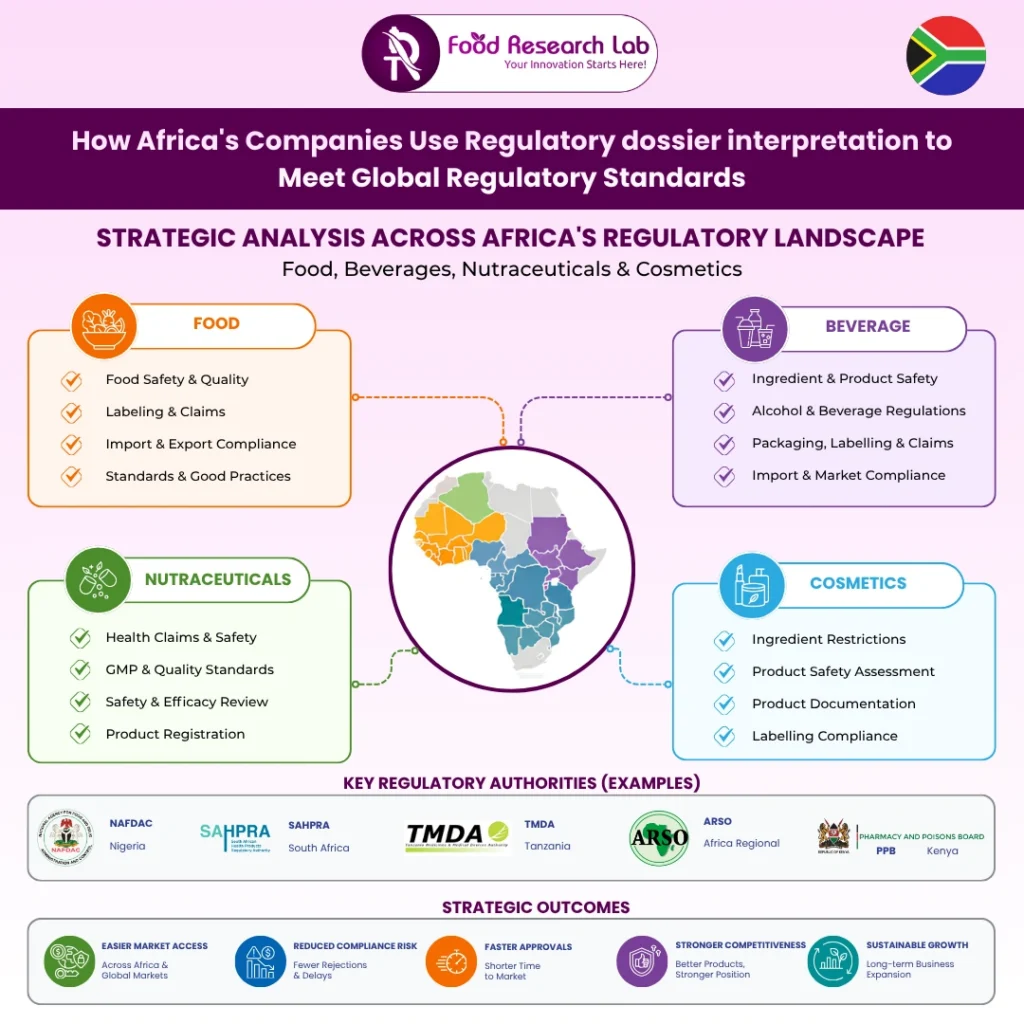
African organizations have been experiencing some of the challenges linked to the regulatory process due to:
- Approval timelines
- Labeling variations
- Ingredient restrictions
- Technical documentation requirements
- Country-specific claims regulations
- Import/export documentation complexity
- Product classification inconsistencies
These regulatory differences make accurate Regulatory dossier interpretation Africa essential for successful African regulatory compliance, reduced approval delays, smoother export registration, and stronger regional market access. Companies increasingly rely on advanced regulatory intelligence systems to monitor changing regional regulations and maintain long-term compliance. [3] [4]
Technical Documentation and Regulatory documentation analysis for Global Alignment
Technical documentation provides the scientific basis for the dossier review process and enables evidence-based validation in Regulatory dossier interpretation Africa. All sections must be subjected to detailed regulatory documentation analysis to meet both African and international regulatory standards in food, beverages, nutraceuticals, herbs, cosmeceuticals, and pet foods.
Ingredient Composition
Review of the active ingredients, inactive ingredients, additives, preservatives, contaminants, raw materials, sourcing systems, and concentrations ensures compliance with international safety levels and food safety regulations Africa. The review of the dossier evaluates the composition of ingredients, potential allergens, and prohibited substances.
Manufacturing Process
The manufacturing procedures must demonstrate uniformity in processes, traceability, validation measures, hygiene control, and quality control measures. In the dossier review process, the regulatory specialists review the manufacturing evidence to confirm adherence to international pharmaceutical regulatory requirements, food safety expectations and manufacturing standards globally.
Stability Studies
Scientific evaluation of shelf life, storage stability, compatibility of packaging, microbial stability, and environmental stability studies contribute to meeting quality standards across the globe. Proper interpretation of stability data enhances submission reliability and preparedness for exporting products.
Clinical or Functional Evidence
Clinical, nutritional proof, herbal, cosmetic, and pet nutrition studies should be able to prove the functionality of products by considering international scientific standards. Regulatory interpretation teams assess efficacy evidence, dosage justification, and claims substantiation to support stronger international compliance strategies.
Toxicology and Safety Data
Assessment of toxicity risks, heavy metals, microbial contamination, allergenicity, dosage safety, consumer exposure, and animal safety is critical for product acceptance. Toxicological interpretation remains essential for nutraceuticals, herbal products, cosmeceuticals, and pet food exports.
Labelling and Claims Compliance
Product labels, nutritional information, instructions, warnings, export labels, and marketing claims should meet country-specific legislation and international dossier submission guidelines. Claims interpretation becomes necessary for functional foods, nutraceuticals, herbal product, and cosmeceuticals. [1] [2] [4]
Compliance management systems and Quality assurance compliance for Global Dossier Acceptance
Effective compliance management systems help to significantly improve African regulatory compliance and enhance acceptance of international dossiers in the food industry, beverage industry, herbal products, nutraceuticals, cosmeceuticals, and pet foods.
Good Manufacturing Practices (GMP)
GMP systems show that the company complies with international standards for manufacturing products of high quality. They provide good technical understanding for Regulatory dossier interpretation Africa. Reviewers of the regulator will examine process validation, quality control, batch consistence data, and documentation on product traceability to ensure alignment with global expectations.
HACCP and Risk-Based Controls
An organized HACCP system enhances food safety documentation and builds trust in food safety regulations Africa, nutraceutical manufacturing systems, beverages, and pet food safety programs. Risk-based controls also improve contaminant management and export compliance.
Quality Management Infrastructure and Regulatory intelligence systems
The regulatory intelligence system, which includes audits, traceability systems, corrective actions, supplier qualification, and digital quality management, enhances the effectiveness and efficiency of the product approval process. These systems help African companies monitor evolving international regulations and maintain stronger long-term compliance.
Strategic Regulatory Outcome
Dossier interpretation along with a robust quality assurance compliance system ensures that companies obtain:
- Faster approvals
- Higher submission success rates
- Reduced compliance risks
- Improved export readiness
- Stronger scientific credibility
- Better alignment with FDA, EMA, WHO, Codex, EFSA, and African harmonization initiatives
These systems strengthen global competitiveness and support sustainable international market expansion. [1] [2] [4]
International compliance strategies Used by African Firms
African companies are increasingly adopting advanced international compliance strategies to improve global competitiveness and strengthen their position in international markets. Organizations now recognize that effective Regulatory dossier interpretation Africa and alignment with global submission systems are essential for smoother approvals, export readiness, and long-term regulatory sustainability.
Conducting scientific gap analysis will help firms identify any discrepancies in the local laws and regulations as compared to international guidelines such as those provided by FDA, EMA, WHO, Codex, and EFSA. In this way, it becomes easier to be compliant with food safety regulations in Africa and ensure compliance with international scientific expectations in areas like food, beverages, nutraceuticals, herbs, cosmeceuticals, and pet foods.
African manufacturers are also increasingly adopting:
- CTD/eCTD submission systems
- Digital compliance platforms
- AI-driven document review systems
- Automated gap analysis tools
- Electronic traceability systems
In addition, regional harmonization initiatives such as:
- EAC
- ECOWAS
- AUDA-NEPAD
- AMA
support stronger cross-border regulatory compliance, harmonized submission pathways, and improved international market entry regulations for African exports. [3]
Sector-Specific Research-Driven Applications Supporting Global regulatory standards Africa
Food, beverage, nutraceutical, herbal, cosmeceutical, and pet food industries across Africa are increasingly using scientific validation and regulatory documentation analysis to strengthen global compliance, improve submission quality, and support export competitiveness.
Table 1: Interpretations of Sector-Specific Regulatory Dossiers for Advanced Consumer Sectors in Africa
Industry Segment | Regulatory Focus | Key Dossier Elements | Dossier Interpretation Level |
Food Industry | Food additives, contaminants, labeling compliance | Ingredient safety, nutritional composition, shelf-life studies | Moderate–High Food safety, labeling, and export compliance |
Beverage Industry | Functional claims, ingredient safety, caffeine limits | Stability data, preservative justification, consumption safety | Moderate–High Functional claims and exposure assessment |
Nutraceutical Industry | Supplement safety, dosage justification, health claims | Clinical data, toxicology, bioavailability, claims support | High Toxicology, efficacy, and dosage validation |
Herbal Industry | Traditional medicine validation, standardization | Phytochemical characterization, safety data, ethnobotanical evidence | High Botanical safety and standardization complexity |
Cosmeceutical Industry | Product safety, dermatological claims | Safety reports, ingredient toxicology, stability data | High Safety, toxicology, and claims substantiation |
Dossier Interpretation Level indicates the complexity and depth of scientific, technical, and regulatory evaluation required during the dossier review process for international compliance.
Future Trends in Regulatory dossier interpretation Africa
The regulatory compliance systems in Africa are gradually becoming more harmonized and science based. With the increasing export operations from various industries such as food, beverages, nutraceuticals, herbs, cosmeceuticals, and pet food products, Regulatory dossier interpretation Africa increasingly focuses on standardization of scientific evaluation processes, risk-based regulatory reviews, and internationally aligned submission procedures.
Harmonization and CTD/eCTD Adoption
One major trend is the growing adoption of CTD/eCTD submission frameworks, which improve consistency in quality, safety, efficacy, manufacturing, and labeling documentation while supporting compliance with international dossier submission guidelines. Harmonization initiatives led by AMA, AfCFTA, EAC, and ECOWAS are also strengthening regional cooperation and improving cross-border regulatory compliance across African markets.
Digital Regulatory Ecosystems and AI Integration
African regulatory authorities are increasingly adopting digital regulatory ecosystems supported by electronic submissions, integrated compliance databases, and advanced regulatory intelligence systems. At the same time, Artificial Intelligence (AI) is emerging as an important tool for automated gap analysis, technical document assessment, predictive compliance evaluation, and scientific regulatory documentation analysis.
Future Regulatory Outlook
These evolving systems are expected to improve the dossier review process, strengthen alignment with global regulatory standards Africa, and support faster international market access for African industries. [6] [7] [8]
Case Study Example in Regulatory documentation analysis in Food Research Lab
Client Requirement and Regulatory Challenge
An African herbal supplement manufacturer approached Food Research Lab for support in adapting its botanical nutraceutical product for EU market entry. The client required complete Regulatory dossier interpretation Africa support to improve global compliance readiness.
FRL identified key regulatory gaps, including lack of phytochemical standardization, limited toxicological safety data, unsupported health claims, and non-compliant EU labeling requirements, which affected the product approval process.
FRL Regulatory and Scientific Approach
FRL conducted detailed regulatory documentation analysis against EU herbal regulatory standards. The team strengthened safety and efficacy evidence, optimized the dossier structure, revised labeling and claims, and improved GMP-oriented quality documentation.
Scientific validation through phytochemical profiling, toxicology review, and stability assessment helped improve regulatory alignment and compliance strength.
Outcome
The revised dossier improved regulatory readiness, strengthened international compliance, and supported successful EU market entry for the herbal supplement product.
Conclusion
As African industries expand into global markets, Regulatory dossier interpretation Africa is becoming essential for stronger African regulatory compliance, faster approvals, and alignment with evolving global regulatory standards Africa across food, beverage, herbal, nutraceutical, cosmeceutical, and pet food sectors. With increasing adoption of CTD/eCTD systems, harmonized regulatory frameworks, and digital compliance models, African companies are strengthening their international market readiness and export competitiveness.
Food Research Lab supports brands through new product development services, regulatory documentation analysis, dossier preparation, scientific validation, safety evaluation, and global compliance support, helping companies develop market-ready products aligned with international regulatory expectations.
References
- Kamara, J., Essien, U., & Labrique, A. (2024). A new era for African health systems: Market shaping and the African Continental Free Trade Area (AfCFTA). Public health challenges, 3(2), e172. https://doi.org/10.1002/puh2.172
- Pihwal, Kapil & Pawar, Neelam & Aamir, Sheikh & Alam, Mohammad & Rathee, Vikas. (2020). A Comprehensive Review On Regulatory Requirements and Registration Process of Pharmaceutical Drug Products in CIS Countries. Applied Clinical Research, Clinical Trials and Regulatory Affairs. 07. https://doi.org/10.2174/2213476X07666200708105237.
- Romero, Robert & Brewer, Megan & Silva, Joseph & Ortiz, Kimberly & Hunter, Charles & Alamu, Rapheal. (2025). Comparative analysis of Nigeria and South Africa EIS models.
- Sithole, T., Mahlangu, G., Walker, S., & Salek, S. (2022). Pharmaceutical Industry Evaluation of the Effectiveness and Efficiency of the ZaZiBoNa Collaborative Medicines Registration Initiative: The Way Forward. Frontiers in medicine, 9, 898725. https://doi.org/10.3389/fmed.2022.898725
- Ali, Faraat & Neha, Kumari & Ilyas, Anam & Ali, Hasan. (2024). Introduction, Challenges, and Overview of Regulatory Affairs. https://doi.org/10.1201/9781003296492-2.
- Nagar K, Choudhary M, Yadav B, Rahi S, Upadhayay A. The future of Regulatory Submissions: Transition to eCTD 4.0. Int J Drug Reg Affairs [Internet]. 2025Sep.16 [cited 2026May4];13(3):77-4. Available from: https://www.ijdra.com/index.php/journal/article/view/788
- Qu, Liping & Li, Xiuli & Xiong, Yin & Wang, Zhun & Zhou, Yuehua & Zou, Wenjun & Tang, Jianyuan & Wang, Mei. (2022). Opportunities and hurdles to European market access for multi-herbal traditional Chinese medicine products: An analysis of EU regulations for combination herbal medicinal products. Pharmacological Research. 186. https://doi.org/106528. 10.1016/j.phrs.2022.106528.
- Owusu-Asante, M., Darko, D. M., Semete-Makokotieia, B., Adeyeye, C. M., Fimbo, A. M., Rukwata, R., Zaki, G., Walker, S., & Salek, S. (2026). Regulatory Performance of African National Medicines Regulatory Authorities Achieving WHO Maturity Level 3: Identifying Best Practices. Therapeutic innovation & regulatory science, 60(1), 260–273. https://doi.org/10.1007/s43441-025-00879-8

Let’s create something Innovative and Delicious together
Food Research Lab strives for excellence in new Food, Beverage and Nutraceutical Product Research and Development by offering cutting edge scientific analysis and expertise.