Compliance-driven packaging in India is undergoing a major transformation, shifting from a functional necessity to a strategic, regulated requirement driven by strict environmental policies, extended producer responsibility (EPR), and food safety standards. Across India, packaging has moved far beyond its traditional role of branding and shelf visibility. The packaging of products such as food product development and beverages, nutraceuticals, herbal, and cosmeceuticals has assumed greater significance and has become an instrument of law, a source of product information, and a means to build consumer trust. Every declaration printed on a pack—from ingredient lists and allergen statements to dosage guidance and marketing claims—can influence market acceptance, regulatory scrutiny, and brand reputation.
How India's Industry Applies Compliance-driven Packaging Review for Advanced Packaging Intelligence
Compliance-driven packaging in India is undergoing a major transformation, shifting from a functional necessity to a strategic, regulated requirement driven by strict environmental policies, extended producer responsibility (EPR), and food safety standards. Across India, packaging has moved far beyond its traditional role of branding and shelf visibility. The packaging of products such as food product development and beverages, nutraceuticals, herbal, and cosmeceuticals has assumed greater significance and has become an instrument of law, a source of product information, and a means to build consumer trust. Every declaration printed on a pack—from ingredient lists and allergen statements to dosage guidance and marketing claims—can influence market acceptance, regulatory scrutiny, and brand reputation.
With increasing competition and rapid product launches in Indian markets, there has been a marked increase in the number of SKUs, multilingual labels, exporting options, and faster approval processes. This shift has significantly increased the need for structured regulatory packaging review systems and packaging compliance solutions that can identify risks before products reach printers or retail shelves. As a result, many brands are adopting compliance-driven packaging in India supported by advanced packaging intelligence India. [1]
What is Compliance-driven Packaging Review?
Compliance-led packaging reviews are systematic ways of assessing how packaging artwork, labels, and other declarations comply with pertinent regulatory, technical, and commercial needs before manufacturing. It is essential in ensuring that compliance management in packaging takes place effectively and helps in maintaining high packaging quality control India measures.
It generally includes:
- Verifying mandatory label declarations in accordance with packaging regulations India
- Accuracy ingredients for ingredient and nutrition declarations related to food safety packaging
- Review of claims like natural, immunity boosting, sugar free, and dermatologically tested
- Packaging material suitability assessment
- Artwork version control and print approval governance
- Labeling verification for export markets where necessary
Instead of seeing packaging as the final step towards launching the product, this approach brings compliance into the earlier stages of development. It will help to avoid expensive printing mistakes, delays in launches, regulatory problems, customer complaints and improve quality assurance packaging processes. [2]
Why Indian Brands Are Investing in Packaging Intelligence and Compliance Management in Packaging
The Indian brands are now focusing on packaging intelligence due to increasing regulatory and financial risks as well as stringent enforcement and regulations within the framework managed by the Food Safety and Standards Authority of India.
1. Growing regulatory and financial risk
Misleading or incorrect labeling could lead to sanctions under the Food Safety and Standards Act, 2006. Under Section 53, there is the potential to incur a fine of up to ₹10 lakh for false description or misleading advertising, and under Section 55, there is a fine of up to ₹2 lakh for failure to comply with enforcement directions, which directly impacts the business. [3]
2. Mandatory labelling and recall exposure
Food Safety and Standards Authority of India packaging and labelling regulations require accurate ingredient lists, allergen statements, nutrition panels, and FSSAI‑linked identifiers. If labels do not match the product, authorities can trigger relabelling, withdrawal, or recall, creating substantial cost exposure for multi‑SKU portfolios.
3. Claim‑driven nutraceutical and herbal categories
The Food Safety and Standards (Labelling and Display) Regulations, 2020 prohibit health, nutritional and functional claims, while additional AYUSH linked considerations restrict the usage of certain therapeutically styled wording in nutraceutical and formulation of herbal product. Non-compliant claims come under the purview of Section 53, which compels brands to move towards automation in packaging review and AI in packaging industry solutions for pre-print validation.
4. Multilingual and version‑control complexity
Package labels should be “easily readable” in English or Hindi and, wherever applicable, in the state‑prevailing language, making for greater complexities in multi-state label portfolios. In the absence of version management through digital means, manual processes become prone to outdated, inconsistencies or errors in multilingual artwork.
5. Rising enforcement and recall scrutiny
According to the Food Recall Framework issued by the FSSAI, along with associated FAQs, it appears that package non-compliance in terms of allergens or non-compliance claims is an increasingly common reason for enforcement actions or product recalls. This trend is compelling Indian brands in foods, beverages, nutraceuticals, herbs and cosmeceuticals sectors to adopt structured, intelligence‑driven packaging review systems instead of relying on manual checks. [4]
What is Advanced Packaging Intelligence in India and AI in Packaging Industry?
Advanced packaging intelligence India is the employment of digitalization and automated mechanisms using information-driven approaches to enhance packaging efficiency, efficacy, and accuracy. It represents the growing role of AI in packaging industry transformation.
This may include:
- An AI-powered system of packaging label checking that allows for automation in packaging review
- OCR system for comparing approved artwork and final print files
- Automated rule check processes according to packaging regulations India
- Multilingual text verification
- QR code traceability systems enhancing food safety packaging
- Anti-counterfeit packaging integration
- Centralized dashboards for packaging compliance solutions
These systems allow companies to shift from corrective measures to predictive and intelligence-based processes in packaging quality control India. [5]
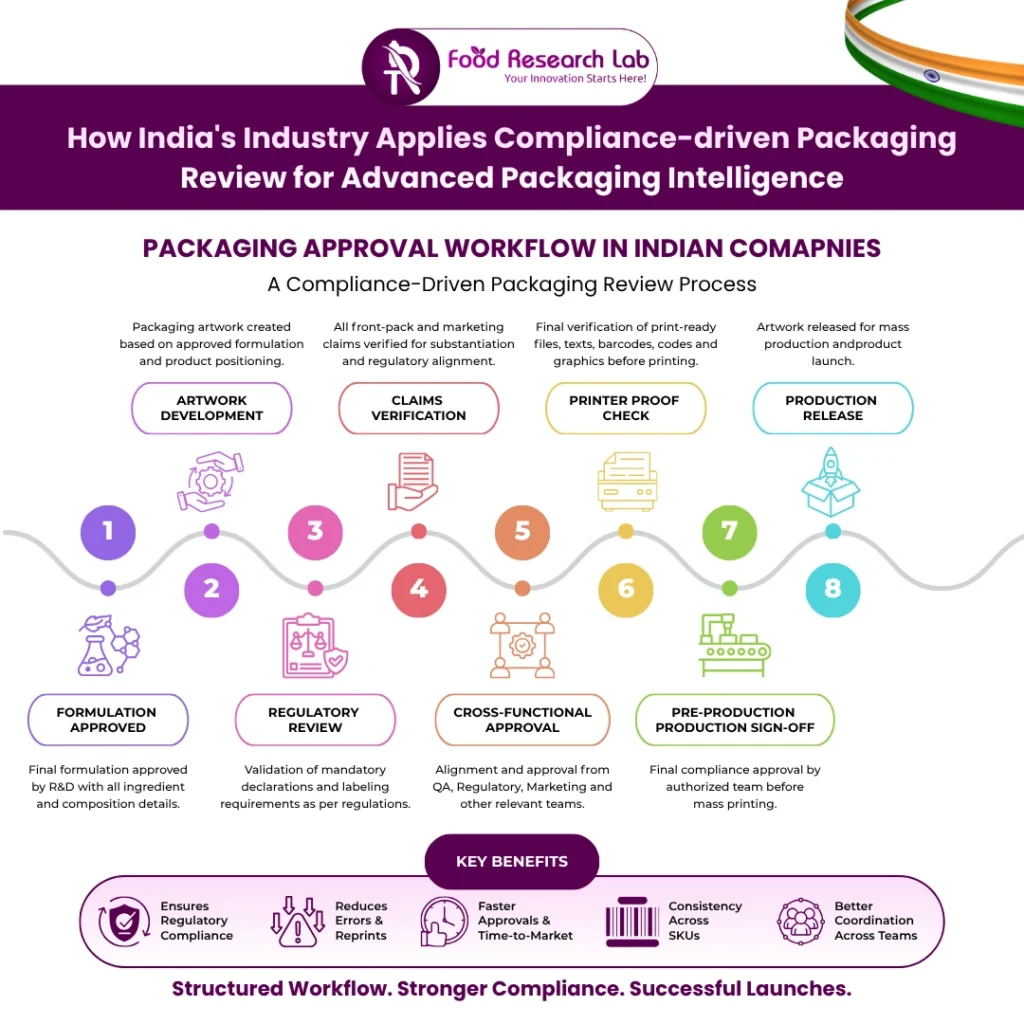
When Should Packaging Compliance Review Begin?
A very common gap that can exist in the process of product development is viewing packaging compliance as the last step in the process. This needs to be incorporated in the beginning stage itself while developing products for compliance driven packaging in India.
Packaging review should be initiated:
- At the Formulation Stage: To make sure that all the claims, ingredient declarations, and positioning are aligned from the start
- Before Artwork Finalization: So regulatory and claim validations are completed before design lock to ensure labelling compliance.
- Before Printing: Final compliance check to avoid costly reprints and corrections
- During Reformulation or SKU Changes: Every time there is a change in ingredients, claims, or pack sizes, there should be another round of packaging review to ensure quality assurance packaging.
Early-stage integration of compliance-driven packaging review helps reduce errors, improve approval timelines, and ensure smoother product launches and overall compliance management in packaging. [6]
How India’s Industries Apply Compliance-driven Packaging Review
Across sectors in India, packaging review requirements vary based on product risk, regulatory expectations, and claim sensitivity. While food and beverage focus on safety and declarations, nutraceutical, herbal, and cosmeceutical categories require tighter control over claims, ingredient accuracy, and consumer communication.
The table below highlights how compliance-driven packaging review is applied across key industries:
Cross-Industry Packaging Compliance Snapshot in India
Industry | Regulatory Authority | What is Reviewed in Packaging | Key Compliance Risk |
Food | Food Safety and Standards Authority of India | Ingredient list, allergens, nutrition panel, veg/non-veg symbol, batch & shelf-life | Nutrition values not updated after reformulation |
Beverage | Food Safety and Standards Authority of India | Sugar, caffeine, sweetener declaration, functional claims, pack consistency | Overstated functional or energy claims |
Nutraceutical | Food Safety and Standards Authority of India | Claims validation, dosage, warnings, nutrient declaration, active ingredients | Drug-like or therapeutic claims |
Herbal | Ministry of AYUSH | Botanical names, classification, dosage, caution statements | Missing botanical identity |
Cosmeceutical | Central Drugs Standard Control Organization | INCI names, SPF/efficacy claims, shelf-life, safety statements | Misleading efficacy claims |
Export Packaging Compliance: Global Packaging Regulations India Perspective
With expanding Indian brands across the world, the need for adaptation of packaging, not only for brand identity, but for region-specific regulatory compliance. Export packaging review goes beyond domestic requirements and requires alignment with destination country rules.
Key considerations include:
- Label Adaptation: Product labels must be reformatted to meet country-specific regulations (e.g., EU, GCC, US)
- Ingredient Nomenclature: Use of standardized naming systems such as INCI for cosmetics or internationally accepted ingredient terms
- Language Requirements: Mandatory translation into local languages (e.g., Arabic for GCC, French for parts of EU)
- Claim Restrictions: Health, nutrition, and efficacy claims must comply with local regulatory frameworks and may differ significantly from Indian allowances
- Importer & Traceability Details: Inclusion of importer name, address, country of origin, and traceability identifiers
- Regulatory Symbols & Markings: Compliance marks such as recycling logos, conformity marks, or category-specific symbols
Failure to align packaging with export regulations can result in shipment rejection, relabeling at destination, global packaging compliance solutions and delay market entry. [7]
Core Packaging Compliance Solutions and Quality Assurance Packaging Controls in India
Regulatory Label Verification
Prior to printing, the declaration of mandatory elements, units of measurement, product identity and statements required are verified against current packaging regulations India and ensure complete labelling compliance.
Claims & Marketing Statement Review
Review of marketing claims such as Natural, Sugar Free, Immunity Boosting, Ayurvedic, or Dermatologically Tested are done as a part of regulatory packaging review and compliance management in packaging.
Ingredient-to-Label Matching
Formula ingredients are matched against ingredient declaration, allergen and active declarations to avoid mismatches and improve food safety packaging and accurate product representation.
Packaging Material Compliance
The brands assess the food safety compliance, suitability of the container, migration risks and sustainability considerations in packaging quality controls in India standards.
Artwork & Print Governance
Packaging review systems through version control, automation in packaging review process reduces risks of using out-of-date artwork, multilingual mistakes, typographic errors and incorrect pack size rollout, strengthening overall packaging compliance solutions. [7]
Industry Insight from Food Research Lab: Nutraceutical Packaging Claim Correction Case
A nutraceutical brand preparing to launch protein + immunity supplement SKUs identified critical packaging gaps during pre-commercial review. The issues were not generic—they were high-risk compliance mismatches affecting overall compliance management in packaging and regulatory packaging review:
- Front-pack claims exceeded what the formulation could substantiate (e.g., implied therapeutic benefits)
- Nutrient values on the label did not align with final batch formulation data
- Mandatory warning statements were incomplete for specific consumer groups
- Multiple SKU variants had inconsistent artwork versions ready for print
What FRL Did
- Claim Alignment: Reworked front-pack claims to ensure they were structure/function-based, not drug-like, strengthening labelling compliance
- Data Synchronization: Matched nutrient panel values with validated formulation and batch data to support food safety packaging accuracy
- Regulatory Label Fixes: Added and standardized mandatory warning statements and usage directions
- Artwork Control: Established single approved artwork versions across all SKUs before print release using structured packaging compliance solutions
- Pre-print Compliance Gate: Final verification checklist supported by automation in packaging review to prevent outdated or incorrect files going to production
Outcome
- Eliminated high-risk labeling errors before commercialization
- Prevented multi-SKU reprint and market withdrawal scenarios
- Enabled faster, compliant product launch with consistent packaging across variants
- Strengthened overall packaging quality control India practices
This case highlights how early-stage compliance-driven packaging in India can directly reduce regulatory risk while improving speed-to-market in nutraceutical categories.
Conclusion
Packaging has become an important aspect in India where it influences compliance, speed-to-market, and consumer trust. Companies are no longer relying on basic labeling checks, and have moved on to more intelligent, systematic approaches based on advanced packaging intelligence India.
To ensure your packaging is regulatory-ready and market-optimized, partner with Food Research Lab for expert-led packaging compliance solutions, regulatory packaging review, and end-to-end service of food product development launch support.
References
- Pande, B., Chandorkar, S., & Singh, M. (2025). Decadal transition in food labelling compliance with the Food Safety and Standards Authority of India regulations and the nutritional composition of processed packaged foods: Implications for public health. World Nutrition, 16(3), 120–131. https://doi.org/10.26596/wn.2025163120-131
- Dangi, N., Chaturvedi, R., & Singh, N. (2025). A comparative study of food labels in the United States and India: Adherence to Codex Alimentarius guidelines. Journal of Emerging Investigators, 8(1). Retrieved from https://emerginginvestigators.org/articles/24-180/pdf
- Food Safety and Standards Authority of India. (2006). Legal implication of Food Safety and Standards Act, 2006. https://fda.assam.gov.in/sites/default/files/swf_utility_folder/departments/cfs_lipl_in_oid_10/menu/document/Legal%20implication%20of%20FSS%20Act,%202006.pdf
- Food Safety and Standards Authority of India. (2025). Compendium of packaging regulations (Version 02-04-2025). https://fssai.gov.in/upload/uploadfiles/files/Compendium_Packaging_V_%2002-04-2025.pdf
- Madhu, B. (2025). AI-driven food packaging systems: A new frontier in intelligent food safety and shelf-life management. Journal of Food Science, 90(12), e70716. https://doi.org/10.1111/1750-3841.70716
- Tran, T. Y. A., Nguyen, T., Herat, S., et al. (2025). Monitoring and assessing EPR compliance of producers and importers to prevent free riders in developing countries: The case of Vietnam. Circular Economy and Sustainability, 5, 6171–6198. https://doi.org/10.1007/s43615-025-00703-3
- Thapliyal, D., Karale, M., Diwan, V., Kumra, S., Arya, R. K., & Verros, G. D. (2024). Current status of sustainable food packaging regulations: Global perspective. Sustainability, 16(13), 5554. https://doi.org/10.3390/su16135554
- Bera, O. P., Singh, R., & Bhattacharya, S. (2023). Food literacy & food labeling laws—A legal analysis of India’s food policy. Journal of Family Medicine and Primary Care, 12(4), 606–610. https://doi.org/10.4103/jfmpc.jfmpc_880_22

Let’s create something Innovative and Delicious together
Food Research Lab strives for excellence in new Food, Beverage and Nutraceutical Product Research and Development by offering cutting edge scientific analysis and expertise.