A sensory profile is an assessment tool used to evaluate how an individual perceives and responds to everyday sensory information (like sights, sounds, smells, and touch). This new approach has become a key research and marketing solution for EU companies that can help them to compete in the tough market environment, improve their food product development process, and understand consumer behaviour better. In the modern world when consumers are interested in premium, sustainable, and personalized products, sensory profiling enables companies to turn customer data into innovations and minimize the risk of commercialization failure within the framework of product innovation Europe. [1]
Decoding Consumer Preferences: How EU Brands Leverage Sensory Profiling for Market Success
A sensory profile is an assessment tool used to evaluate how an individual perceives and responds to everyday sensory information (like sights, sounds, smells, and touch). This new approach has become a key research and marketing solution for EU companies that can help them to compete in the tough market environment, improve their food product development process, and understand consumer behaviour better. In the modern world when consumers are interested in premium, sustainable, and personalized products, sensory profiling enables companies to turn customer data into innovations and minimize the risk of commercialization failure within the framework of product innovation Europe. [1]
What Is Sensory Profiling?
Sensory profiling is a scientific approach to measuring consumer reactions to a certain product in terms of its taste, smell, texture, and even appearance. The information collected via expert panels and consumer data allows to understand which properties of the products make customers purchase them.
Market Growth and CAGR Trends in EU Sensory Profiling Industries
Pushed by an increase in demands for clean label products, personalized nutrition, sustainability, and advanced sensory research methodologies powered by Artificial Intelligence, the European sensory profiling industry is witnessing substantial growth. The usage of sensory profiling has been extended from conventional fields like food and cosmetics to beverages, herbal products, cosmeceuticals, nutraceuticals, pet foods, and others. AI-powered Sensory intelligence and nutraceutical sensory research are anticipated to register strong growth with the increasing adoption of data analysis techniques for consumer research.
Table 1: European Sensory Profiling Industry CAGR by Sector
EU Sensory Profiling Sector | Estimated CAGR (%) | Key Growth Drivers | Strategic Industry Impact |
Food Sensory Testing | 8–10% | Clean-label products, taste optimization, regulatory compliance | Supports product reformulation, innovation, and consumer acceptance |
Beverage Sensory Profiling | 7–10% | Functional beverages, low-sugar formulations, premium drinks | Improves flavour optimization and market differentiation |
Cosmetics Sensory Intelligence | 7–9% | Personalized beauty products, fragrance evaluation, texture optimization | Enhances customer experience, branding, and loyalty |
Cosmeceutical Sensory Research | 8–10% | Performance-driven skincare, anti-aging products, efficacy perception | Strengthens product validation and premium market positioning |
Nutraceutical and Wellness Sensory Research | 8–11% | Personalized nutrition, functional foods, health-focused innovation | Facilitates product acceptance and commercialization |
Herbal Product Sensory Profiling | 7–9% | Natural ingredients, botanical formulations, consumer trust | Supports product standardization and market expansion |
Pet Food Sensory Profiling | 6–9% | Premium pet nutrition, palatability testing, pet humanization trends | Enhances product preference and brand competitiveness |
Retail Product Testing | 6–8% | Consumer evaluation, private-label expansion, rapid innovation cycles | Improves product launch success and customer satisfaction |
AI-Driven Sensory Intelligence Solutions | 9–12% | Machine learning, predictive analytics, automated sensory evaluation | Enables advanced market intelligence and innovation |
Sustainable Product Sensory Validation | 7–10% | Plant-based products, eco-friendly formulations, sustainability goals | Builds consumer confidence and sustainability credentials |
Regulatory Sensory Quality Assurance | 6–8% | Compliance requirements, quality management systems, safety standards | Ensures consistency, regulatory readiness, and product reliability |
Within the European market, AI based sensory intelligence, nutraceutical sensory research and new age sensory profiling in beverages and cosmeceuticals would lead market growth as these would benefit from the increasing investment in digital consumer research, personalized products and sustainable products. As European consumers are becoming increasingly demanding towards the quality, performance, and sensorial properties of products and as a result they are favouring brands providing enriched consumer experience; market research has an increasing scope of benefiting from sensory profiling applications in various sectors of European markets. [2]
Consumer Behaviour and Factors Driving Demand in EU Sensory-led Markets
The increasing importance of health, sustainability, personalization, and premium product experiences among European consumers has significantly influenced demand for Sensory attributes in product development. Factors such as taste, scent, texture, mouthfeel, and visual appeal now play a major role in consumer purchasing decisions, while product perception is increasingly shaped through advanced sensory evaluation process methodologies.
European brands increasingly rely on sensory-driven consumer research to generate deeper market intelligence by identifying emotional triggers, purchasing motivations, sensory expectations, and behavioural patterns across different demographic groups. Sensory marketing strategies are now widely used to strengthen category positioning, improve consumer engagement, and enhance commercialization success across competitive EU markets.
Gen Z consumers prioritize authenticity, sustainability, and personalized experiences, while millennials focus heavily on wellness, transparency, ethical sourcing, and premium quality. These changing consumer expectations have increased the importance of Product enhancement through sensory analysis across food, beverage formulation, nutraceuticals, herbal products, cosmeceuticals, and wellness sectors throughout Europe. [3]
Sensory Profiling Applications Across EU Consumer and Market Research Industries
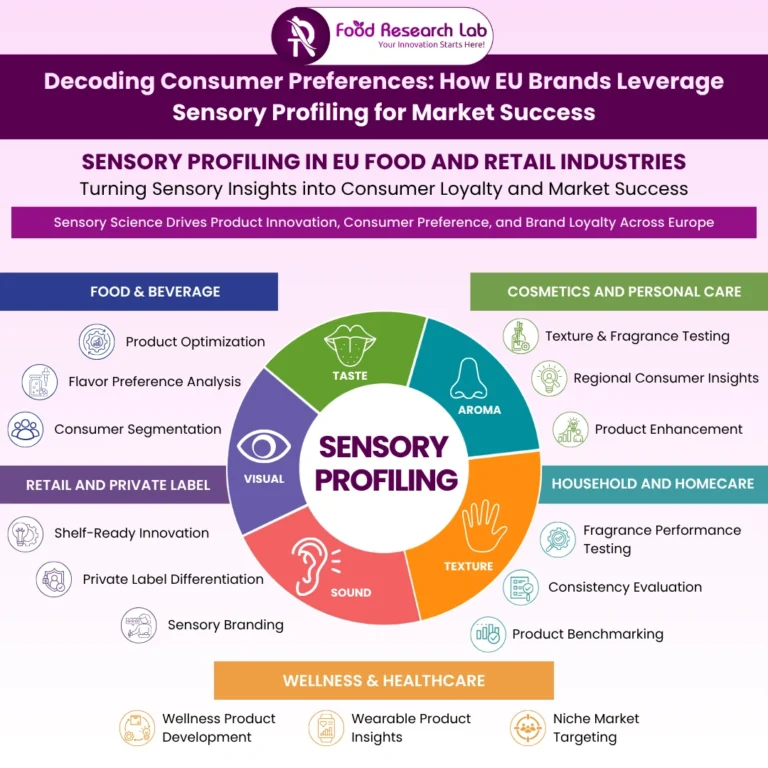
Beyond the original role in product testing, sensory profiling is now utilized as a strategic market research tool, enabling Sensory profiling in EU food and retail industries to identify consumer desires, fine-tune product efficacy and enhance their market position. Industries employ sensory data for product innovation, consumer segmentation, product quality enhancement, commercialization by connecting sensory data with consumption behavior and satisfaction levels. Due to growing consumer demand for tailored, sustainable and high-quality products across the EU, organizations are increasingly utilizing sensory profiling at all stages of product development including marketing, product verification, Product testing and sensory science.
Table 2: Application of Sensory Profiling Across EU Industries
Industry Sector | Key Sensory Profiling Applications | Consumer & Commercial Benefits |
Food & Beverages | Taste, aroma, texture, and flavor optimization | Improved consumer acceptance and product innovation |
Retail & Private Label | Product comparison, packaging evaluation, sensory branding | Stronger differentiation and launch success |
Cosmetics & Personal Care | Fragrance, texture, and skin-feel assessment | Enhanced customer satisfaction and brand loyalty |
Home Care Products | Fragrance and performance evaluation | Increased consumer trust and repeat purchases |
Nutraceuticals & Wellness | Palatability and user-experience testing | Higher product acceptance and market adoption |
These applications highlight the contribution of sensory profiling to evidence-based product development, market entry risk reduction and consumer-centric innovation in a variety of European business sectors.
Core Sensory Evaluation Process and Analytical Methodologies
An effective Sensory evaluation process combines traditional sensory science methodologies with modern AI-driven technologies to generate accurate consumer insights and support smarter commercialization strategies for EU brands. The integration of advanced Sensory analysis techniques with predictive analytics allows organizations to understand consumer expectations more effectively while accelerating innovation and market readiness. [4] [5]
Standard Sensory Analysis Techniques
- Descriptive analysis provides a quantitative assessment of the sensory attributes (taste, aroma, texture, appearance and colour) enabling the detailed profiling of consumer preferences.
- Free-choice profiling is utilized in situations where consumers are encouraged to describe products using their own vocabulary, allowing for richer consumer responses.
- Discrimination testing helps to establish whether there are significant differences between products or reformulated products for product validation or comparative purposes.
- Hedonic testing assesses the likes and dislikes, enabling both an assessment of consumer’ emotions as well as market opportunity and potential.
- Consumer acceptance testing measures the consumer’ liking and purchase intent and thus the market readiness.
Advanced Sensory Intelligence Solutions
Modern Sensory intelligence solutions utilize artificial intelligence, machine learning, and behavioural analytics to predict consumer responses to sensory stimuli. These technologies enable organizations to segment consumers based on sensory preferences, purchasing behaviour, emotional engagement, and lifestyle expectations.
AI-driven sensory models also support faster innovation cycles, targeted product positioning, and improved forecasting accuracy across food, beverages, nutraceuticals, cosmeceuticals, herbal products, and pet food industries. Furthermore, digital sensory testing platforms facilitate rapid multi-country evaluations across European markets while reducing research costs and development timelines.
Sensory Marketing Strategies for Product Innovation Europe
Sensory marketing strategies have become indispensable for European brands willing to transform their ideas into viable products through consumer-oriented approaches. [6]
Commercializing Sensory Data for Market Success
Sensory profiling is essential for improving prototypes, analysing strengths and weaknesses related to the sensory attributes of the new product formulation, and making appropriate changes to make it more consumer-friendly and promote repeat sales. The optimization of sensory properties, including taste, aroma, feel, and even packaging design, fosters deeper consumer engagement and facilitates brand recognition.
Competitive Advantages for EU Brands
The integration of Sensory quality assurance methods during the initial stages of developing new products can help save money on reformulations and speed up market entry, thereby enhancing customer satisfaction and facilitating innovation returns. Understanding consumer preferences through sensory profiling has become a competitive advantage for European brands.
Best Practices in Consumer and Market Research Through Sensory Profiling
To attain meaningful and applicable insights from the varied European consumers, it is imperative that effective research frameworks be implemented. Robust sensory profiling methods can help organizations to gather a better understanding of consumer attitudes, support the development of products and drive business performance across a range of European markets. [1] [2]
Effective Research Frameworks
Combining expert sensory panels with valid consumer inputs increases the precision and applicability of the research findings, especially when used to analyse Food sensory testing solutions. Cross-validation, multilingual research, and the calibration of instruments in accordance with cultural preferences help ensure accurate results from the comparisons between various European markets for Product innovation Europe purposes.
Common Market Research Pitfalls
Mistakes such as inadequate sample size, insufficient consumer participation, and incorrect interpretation of sensory data could affect the validity of the findings. Such mistakes may result from ignoring cultural differences and regional preferences among other factors.
Future Trends in Sensory Profiling and Consumer Market Intelligence
The combination of artificial intelligence and digital transformation with the increase in consumer demand for sustainable products has made sensory profiling one of the most effective tools for market intelligence. Businesses throughout Europe are adopting sophisticated sensory intelligence tools to understand the change in consumer perception, shorten their innovation and commercialization process. [5] [7]
AI and Digital Transformation
The use of virtual sensory profiling, predictive analysis, and machine learning algorithms helps predict consumer behaviour and their reaction to any product. This trend has helped organizations working in food, beverages, cosmetics, and wellness industries enhance consumer segmentation, forecasting trends, and product development more efficiently. The use of digital sensory testing for rapid, multi-market evaluation also aids in minimizing cost of research, shortening the innovation time.
Sustainability and Next-Generation Product Enhancement
As the consumer demand for sustainable and customized products is increasing, Product Innovation Europe has started prioritizing product innovation that takes care of the sustainability objectives of the organization along with enhancing the sensory experience of consumers. Personalized sensory optimization, a segmentation-based approach to tailor experiences, is widely adopted in health and beauty, food and wellness industries.
Case Study: Enhancing Products Using Sensory Analysis in EU Food Innovation
Client Overview
An EU based manufacturer of snacks sought to reduce salt and sugar content of its baked snacks without sacrificing taste or consumer acceptability across key European markets (Germany, France, Italy, and Spain).
Key Challenges
- Increasing nutritional content while keeping the sensory aspects of the food
- Understanding tastes for different European consumers
- Decreasing the risk of commercialization of new products
Sensory Analysis
Food Research Lab implemented descriptive profiling and acceptance studies, also incorporating hedonic tests. An AI approach was taken to segment consumers by purchasing intent, taste preferences and sensory requirements to maximize the chance of success and product differentiation.
Sensory Validation
Multiple prototypes were tested and validated using trained sensory panels and consumer studies across all targets European countries, adjusting tastes to consumer expectations on a country-by-country basis without compromising formulation.
Key Outcomes
- The product became more acceptable to consumers through a 20% decrease in sugar and a 15% decrease in salt, leading to an 18% increase in repeat purchase intention via fine-tuned flavor.
- The process also generated 15% cost savings in reformulation, and accelerated product development by 20%.
- As a result, consumer acceptance overall improved by 22%, providing a competitive edge in the European retail space through data-driven sensory science.
Conclusion
Sensory profiling has become an essential tool that can help ensure success in the process of commercialization in the EU. Using this approach, it is possible to convert consumers’ perceptions into a powerful marketing tool. The key benefits of using sensory profiling include innovations, the validation of the product in the market, reduction of risks associated with commercialization, and the development of customer loyalty. With the right sensory marketing strategies and thorough knowledge of consumer intelligence, sensory profiling will enable EU companies to gain competitive advantages.
Food Research Lab supports firms with all aspects of their food product development services including consumer research, sensory product evaluation and validation, product optimization, market intelligence, regulatory affairs, and commercialization strategy.
References
- Scharf, A. (2011). Sensory marketing research – Identification of the ideal sensory product profile. In: Sidali, K., Spiller, A., Schulze, B. (eds) Food, Agri-Culture and Tourism. Springer, Berlin, Heidelberg. https://doi.org/10.1007/978-3-642-11361-1_12
- Sandra S. Waehrens, Ilona Faber, Limei Gunn, Patrizia Buldo, Michael Bom Frøst, Federico J.A. Perez-Cueto, Consumers’ sensory-based cognitions of currently available and ideal plant-based food alternatives: A survey in Western, Central and Northern Europe, Food Quality and Preference, Volume 108, 2023, 104875, ISSN 0950-3293, https://doi.org/10.1016/j.foodqual.2023.104875. (https://www.sciencedirect.com/science/article/pii/S0950329323000691)
- Zha, D., Foroudi, P., Melewar, T.C. et al.Examining the Impact of Sensory Brand Experience on Brand Loyalty. Corp Reputation Rev 28, 14–42 (2025). https://doi.org/10.1057/s41299-023-00175-x
- Karima A. Moussaoui, Paula Varela, Exploring consumer product profiling techniques and their linkage to a quantitative descriptive analysis, Food Quality and Preference, Volume 21, Issue 8, 2010, Pages 1088-1099, ISSN 0950-3293, https://doi.org/10.1016/j.foodqual.2010.09.005. (https://www.sciencedirect.com/science/article/pii/S0950329310001618)
- Mehmet Melikoglu, Instrumental-analytical integration in food sensory evaluation: Current trends and future horizons, Microchemical Journal, Volume 221, 2026, 116942, ISSN 0026-265X, https://doi.org/10.1016/j.microc.2026.116942. (https://www.sciencedirect.com/science/article/pii/S0026265X26001426)
- Republic, Czech & Starostova, Adriana. (2017). The Role of Sensory Marketing in Product Innovation.
- Ceballos, Lina M. & Giraldo, Juan & Velasco, Carlos & Reinoso Carvalho, Felipe. (2025). The Future of Sensory Marketing-Expanding Customer Experiences Through Advanced Technologies.

Let’s create something Innovative and Delicious together
Food Research Lab strives for excellence in new Food, Beverage and Nutraceutical Product Research and Development by offering cutting edge scientific analysis and expertise.