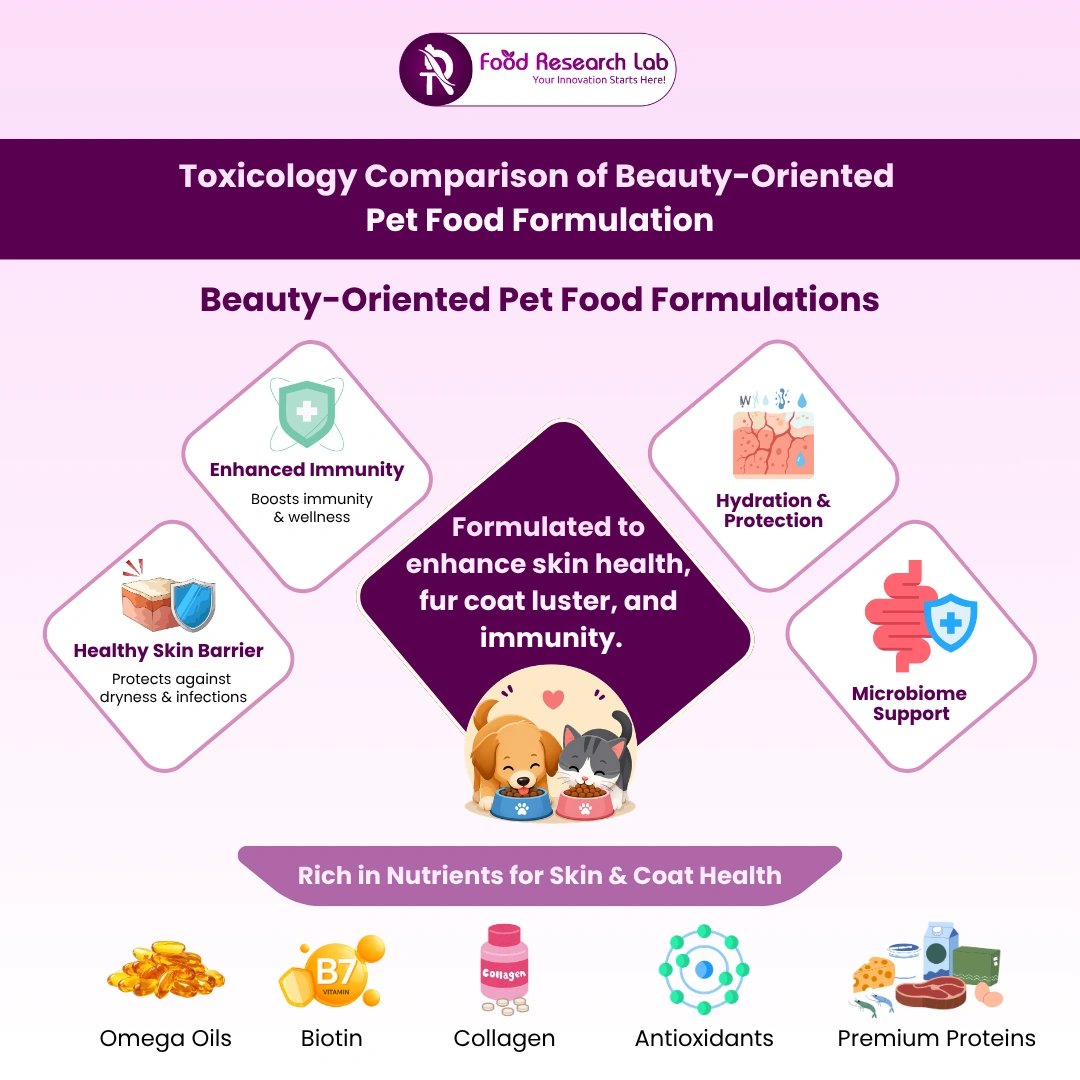
Beauty pet food formulations focus on skin health and coat luster, typically featuring high-quality proteins, increased omega-3/omega-6 fatty acids, biotin, and antioxidants like zinc. Toxicology of beauty pet food formulations is the scientific basis that helps prevent any negative effects of these functional ingredients while allowing the realization of their beneficial effect. This aspect bridges the gap between enhanced appearance and general physiological safety through the application of certain basic principles like risk evaluation, dose-response approach, and NOAEL.
It is important to mention the significance of toxicological evaluation for recognizing possible threats associated with the use of certain active substances, possible contamination, and over-supplementation. In this context, the Toxicology of beauty pet food formulations becomes essential for product safety assurance. With respect to this, it becomes evident that toxicological evaluation is necessary for the safety assurance of products. Toxicological evaluation allows establishing certain safety thresholds that depend on physiological reactions to varying exposure levels. This supports ingredient safety analysis and ensures safe ingredients for pet skin and coat. [1]
Beauty-based pet food formulations refer to the type of food designed to improve the aesthetic value of a pet by improving the external characteristics, including the quality of its skin and fur coat as well as its general appearance, while ensuring that its internal organs are healthy. These formulations include omega oils, biotin, collagen, antioxidants, and proteins to ensure optimal nourishment for the skin and fur coat of the pet, which support omega fatty acids, pet skin health, and overall nourishment.
Other advantages go beyond the visual aspect since such diets protect the skin from drying up and other related issues, such as infections through the skin barrier and microbiome support. This aligns with clean-label pet food trends and ensures safe ingredients for pet skin and coat. Pets will enjoy enhanced immunity, comfort, and wellness. [2]
Formulations that promote beauty incorporate biologically active agents, herbs, and nutraceuticals, including omega fatty acids, collagens, and antioxidants, which, however, present toxicological challenges if not regulated properly. Potent ingredients and chemical additives in pet food risks will cause skin irritation, sensitization, and phototoxicity, while the presence of metals, pesticides, and other residual chemicals poses additional safety threats. Over-supplementation may disrupt metabolism, and some compounds may bioaccumulate, leading to long-term effects like endocrine disruption and long-term effects of pet food additives. Importantly, toxicity comparison shows that risk is not based on origin, as both natural vs synthetic pet nutrients and artificial preservatives pet food risks require evaluation. This reinforces the role of Toxicology of beauty pet food formulations in maintaining product safety [3]
The table below outlines key beauty-oriented ingredients, toxicological risks, and health impacts.
Beauty-Oriented Ingredients | Examples | Toxicological Risk | Impact on Health |
Bioactive compounds & Herbal Extracts | Essential oils, neem, tea tree | Sensitization, phototoxicity | Skin irritation, allergic reactions |
Nutraceuticals | Omega fatty acids, collagen, antioxidants | Over-supplementation, contamination | Metabolic imbalance, toxicity |
Contaminants | Heavy metals, pesticides, 1,4-dioxane | Accumulation in the body | Organ damage, carcinogenic risk |
Synthetic Compounds | Parabens, phthalates | Bioaccumulation, endocrine disruption | Hormonal imbalance |
Nanomaterials | Zinc oxide, titanium dioxide | Oxidative stress | Cellular damage |
Many types of in vitro tests look at how harmful a product might be when placed on an animal’s skin. In vitro, MTT, LDH, and NRU tests to measure if there is cytotoxicity with a particular component added to cosmetics, such as essential oils or antioxidants, and allow the evaluation of potential irritation or cytotoxicity to be completed within a short period of time and at a low cost, supporting toxicity levels in pet nutrition. Additionally, 3D cell cultures and gene expression profiling of a pet’s skin are more sophisticated means of conducting in vitro testing.
Evaluating the effects on the whole body (toxicity and safety of substances) is achieved with in vivo testing methods. The testing methods described above provide essential, aligning with pet food regulatory standards and the use of veterinary approved pet food ingredients. Thus, ethical testing must conform to the 3 R’s guidelines (replacement, reduction, refinement).
Models such as predictive modeling help assess toxicity, absorption, and bioaccumulation of chemicals. The artificial intelligence models will be used to determine the risks and interactions of chemicals in products. These models minimize animal testing and increase the accuracy of chemical toxicity tests.
Combining all types of data is necessary to ensure complete safety testing by minimizing the allergens in pet food formulations. Helpful in achieving equilibrium between beauty effects (skin, coat wellness) and safety. Enables formulation of pet foods that are safe and globally approved. [4]
A leading canine care product manufacturer partnered with Food Research Lab after receiving complaints from dog owners regarding skin rashes that appeared after water exposure following the use of a beautifying formula designed to improve coat shine and skin condition.
Dogs developed skin irritation after water contact, indicating possible phototoxic reactions and ingredient imbalance. The formula had not been validated for species-specific toxicology safety.
FRL conducted a comparison between the current formulation and a validated safer control:
Result
Key Learning
Species-specific toxicology and regulatory compliance are essential for successful innovation in beauty-oriented dog food products.
Toxicology is transforming beauty-oriented pet food formulations by ensuring skin and coat benefits are delivered safely. As brands adopt bioactives, nutraceuticals, and premium ingredients, scientific safety validation becomes increasingly important. Future growth will depend on risk-based formulation design, transparent ingredient systems, and precision nutrition that balances beauty benefits with long-term pet health. Innovations such as computational toxicology and microbiome-integrated products are setting new standards for safety and effectiveness.
Partner with Food Research Lab for end-to-end animal pet food product development focused on toxicology-driven beauty-oriented pet food formulations, from formulation development with highly bioavailable ingredients and digestibility optimization to nutritional validation, product testing, and successful market-ready product development.
Food Research Lab strives for excellence in new Food, Beverage and Nutraceutical Product Research and Development by offering cutting edge scientific analysis and expertise.